Beer and Lying in High Society

Tony from the Adolescents (photo by Todd Taylor)

Tony from the Adolescents (photo by Todd Taylor)

There I was, bombed out of my trick, blathering something into a microphone about porn stars and premature ejaculation and people with carrots up their asses. It was one of those beautifully ugly moments when I felt like a fool and an imposter and a guy on top of the world. And the bizarre thing was, I was supposed to be there. I was one of the opening acts for X.

Now, your first question, or at least the first question everyone I tell the story to asks is, “X? The X?” The answer is, yes, the X from Los Angeles. The band that we all saw giving each other bad tattoos and talking like they were the king shits in Decline of Western Civilization. The X who did “Johnny Hit and Run Pauline” and “White Girl” and “Sex and Dying in High Society.” Exene Cervenka. John Doe. Billy Zoom. DJ Bonebreak. That X.

If you know me, then your second question is, “But dude, you’re not in a band. What the fuck were you doing opening for X?”

Therein lies our story.


A few weeks earlier, I’d opened up for Tony from the Adolescents, but in a different context. Someone had started a new spoken word series over in West Hollywood, and they were inviting a bunch of old LA punk rockers to do spoken word performances. Tony seemed like a no-brainer choice to grace that stage. And Tony, being the good guy he is, shared the stage with a couple of local writers: me and Jim “Money” Ruland. The whole night was a pretty cool setup. It was a nice bar with a cool little stage and a few free drinks for the folks who were reading. I got a chance to get up on that stage and tell a story and sell a couple of books. Ruland got a chance to do the same. Everyone seemed to laugh at the times when I hoped they would. We all had fun. And, as a topper for the evening, we all got to listen to Tony tell us a bunch of rad stories not only from the heyday of early LA punk rock, but right up to the present day. It was cool to see how Tony patched the two scenes together, cool to see one of the LA punk pioneers show how the underground keeps going and keeps growing. Tony ended it up with a story about something that had happened to him while his band was touring with Electric Frankenstein, and his story was so sad and hopeful that it damn near broke my heart.

It was my kind of night.

Afterwards, Tony seemed pretty excited. He said to Ruland and me, “I’d like to get you guys in on the Beatfest that’s coming up in a couple of weeks. Would you be interested?”

“Sure,” I said, having no idea what I was agreeing to.

When I got home, I played the Adolescents blue album for the ten thousandth time and looked into what Beatfest was. From what I gathered, it was a grouping of LA bands and writers that would take place on two stages over the course of three nights. The big stage featured acts like Dee Dee Ramone, Steve Earle, and X. The smaller stage featured a bunch of writers who you’ve probably never heard of, and a bunch of people who you have heard of, but who probably aren’t writers, all of whom were doing some form of spoken word. I figured that Ruland and I would get ten minutes each on the small stage, and that was good enough for me. I quit looking into Beatfest and turned up the stereo.

A few days later, Tony called Ruland. As it turned out, Tony had tried to get us onto the small stage, but he wasn’t able to. No worries, though. He got us onto the big stage for the Friday night show, instead. Ruland and I would go on after the Starvations and before the Adz. X would headline. We’d have five minutes each to read something. “Would that be cool?” Tony asked.

“That sounds great,” Ruland said, because he was lying out his fucking ass.

The thing is, what Jim knew and what I knew was that only one thing flies on the stage of a punk rock show, and that’s a punk rock band. I’ve been to thousands of shows over the course of decades and I’ve seen people try all kinds of shit between bands at shows. I’ve seen someone try to show an independent film, and I’ve seen that movie screen get splattered in beer. I’ve seen the makeshift punk stand up act who had to re-write his material so that his whole comedy routine is nothing more than dealing with hecklers. I’ve seen spoken word acts get it the worst. I’ve come to respect that the time between bands at a punk show as a sacred time: a fifteen minute break for punkers to piss and buy beer and say, “Man, those guys sucked live,” and do whatever else it is that recharges them. So if we took the stage between the Starvations and the ADZ and tried to read short stories, we’d get heckled and booed and otherwise humiliated.

But there was another thing, and it was this: Tony from the Adolescents offered this opportunity to us. I can’t speak for Jim here, but I feel like, when someone puts something out into this world that’s so close to perfect – like that Adolescents blue album – and then they ask you to do something, you owe them. And it goes deeper than that. The first time I spoke to Tony, he’d called up Razorcake HQ with some questions for Todd. Since Todd wasn’t around, I answered Tony’s questions and then asked him about a hundred questions about the Adolescents and the Adz and about that crappy move SLC Punk using the Adolescents’ song “Amoeba.” Tony was patient and chatted about all that stuff with me. It was one of those cool moments when I couldn’t be star struck by the singer of a band that meant so much to me because the singer of that band refused to act like a star. And now he was giving me the opportunity to showcase my writing to hundreds of people at an X show. How could I say no?

So Jim and I had to figure out how we were gonna handle this situation. First, we did what Ruland and I do when left to our own devices: we hung out, listened to music, and drank a whole lot of beer. When the first twelve-pack ran out, we bought more. We drank until a nice haze settled in. Somewhere during that haze, I told Ruland about this weird package I’d gotten in the mail from a friend of mine, Jason Willis.

Jason works in an internet porn company, and the company he used to work for had bought out another porn company, and therefore, they got that other company’s office supplies. So while Jason and his co-workers were raiding this defunct company’s offices, Jason came across a box of letters that guys had written to women in porn. The letters were seriously depraved. The guys genuinely thought that, if you simply write a good enough letter to a porn star, she will have sex with you. So they wrote their love letters. And the porn stars never opened them. They left them in a box in an office. No one touched the box until Jason came across it. At which point, Jason and his friends got a good laugh at these guys’ expense. Actually, everyone who read the letters seemed to go through the same stages: for the first dozen letters, they laughed at the guys who wrote the letters; for the next dozen letters, they sympathized – or pitied, even – the letter writers, as in, “Holy shit, this poor fucker is a thirty-five-year-old virgin who thinks he can have sex with a porn actress. How bad must his life suck?”; and, after another dozen letters, they go back to laughing, as in, “Dude, it’s his own fault he’s a thirty-five-year-old virgin. If he can’t figure out that dirty words written to a porn star aren’t gonna solve his problems, then I can have a guilt-free laugh at his expense.”

The next morning, I emerged from the drunken haze to realize that the letters to porn stars were my key to getting through this opening gig for X. The letters would slide me into that nice gray area where there are exceptions to rules, where you realize that the one thing besides punk rock that will fly at a punk rock show is a dirty joke. So I made up a story about how, when we started Razorcake, we rented a PO Box that used to belong to a porno magazine, and we got all these crazy letters to porn stars. I picked out my favorite letters: the one where the guy asks the German porn star for her opinions on the reunification of Germany; the one where the guy in prison talks about how, when he gets out, he’ll take the porn star horseback riding on the shores of Marina del Rey (which, as far as I can tell, has no “shores,” because it’s a fucking marina, not a beach); the one about the middle aged virgin who’s saving himself for the right porn star; the one that discusses how perfectly the photographer caught the picture just as Chloe’s tongue was about to touch Claire’s asshole, but before the tongue actually touched; and, of course, the one about the guy with the carrot in his ass (and no, he wasn’t the Rhythm Chicken). My plan was to tell my story and have Jim read the letters in between my discussion of the stages of reading the letters.

I called Jim with my plan. He liked it. We decided to meet up at his apartment and practice reading the piece. We did meet up at his apartment. We drank beer and listened to music. When the first twelve-pack ran out, we bought more. Somewhere in the haze of the second twelve-pack, we decided that a.) we didn’t need any fucking practice and b.) we should stop fooling ourselves and just buy a case to begin with.


Before too long, Beatfest came around, and ready or not, Ruland and I packed up and headed out to it. Another fellow Razorcaker, Bradley Williams, lived across the street from the venue, so we left early, headed out to Hollywood, and met up with Bradley. We drank more beer and told stories with Bradley and, shortly before it was time for us to head to the show, Bradley put on his own show for us. He pulled out his washtub bass, which is a broomstick stuck into a round metal washtub, with a cord tied to the top of the broom stick and the edge of the tub. Bradley put on a pair of gardening gloves so the cord wouldn’t tear up his fingers, and ripped through a song on the washtub bass. It was too good. We made Bradley play another. And another. It just felt right. The beer was cold. The songs sounded good. We cheered Bradley on until finally he said, “I can’t play no more. My hands are tore up.”

That meant it was time to go to the show.


Tony seemed glad to see Ruland and me. He showed us around the backstage area, which was strangely free of beer, which didn’t matter because I had one in my hand anyway. He walked us by the room where the members of X were. There was a huge sign on the outside of the door that told anyone and everyone to not disturb the band. It seemed excessive, seeing as how there was no one backstage to except Ruland, Tony, and me, and we were more than content to just disturb each other.

After a few minutes, the Starvations wrapped up their set and it was time for Ruland and me. A big curtain closed at the front of the stage. The Starvations started breaking down behind the curtain. The Adz waited to set up their equipment. The sound guy pulled two microphones out in front of the curtain and told us to do our thing. Tony introduced us. I stepped up to the mic. It was weird. The stage was six feet high. Bouncers stood in front of me, poised to protect me from any stage divers or teeny boppers who wanted to storm the stage. As if that would happen. Literally hundreds of people milled around in front of me. I pulled my story out from my back pocket. I was so nervous and had had so much to drink that I couldn’t read the words on the paper. No worries, though, because this always happens to me when I get up on a stage to do a reading, so I memorized my story in advance. I laid in on my bullshit about how these letters had mysteriously appeared in my PO Box. As I paused, Jim read about the premature ejaculators and the marina cowboys. The crowd actually stopped to listen. Not the whole crowd, but a lot of them. Literally hundreds of them. They laughed at all the dick and ass jokes. It was pretty sweet: one of those moments when I was somewhere between a fool and king. Ruland seemed to dig it, too.

After we finished up, the Adz played a pretty fucking awesome set, and then it was time for X. Now, I’m like you. I have X’s Los Angeles album. I have Wild Gift. I’ve listened to them hundreds, if not thousands of times. There was a point in my life when those albums were my soundtrack. The songs from those albums bring back all the feelings from the times when I couldn’t hear them enough. I listen to them and feel years melt away and remember faces and things that I never think about anymore. I reserve those songs for special times when I want to feel like I’m back in some long forgotten era, hanging out with all the people I’ve long since lost touch with. So seeing X play was a pretty special thing for me. Until X took the stage, that is.

They started with one of their hits. I think it may have even been “Johnny Hit and Run Pauline.” It was one of my favorites, but they played it a beat too slowly, and it wasn’t a fast song to begin with. Exene twirled and spun around like she wanted to be some kind of punk rock Stevie Nicks. Clearly she didn’t realize what a contradiction it is to be a punk rock Stevie Nicks. Billy Zoom took his cool guitar pose from twenty years earlier, but not like he was kid who thought he was cool. Like he was an aging comedian performing a Billy Zoom satire. I started drinking faster.

Four songs into the show, X played “We’re Desperate.” I watched John Doe sing out that he was desperate, and I should get used to it. And I thought, dude, I know that you’ve been in over forty movies and have a recurring role on a TV show. You’re not desperate. You’re fucking loaded. Tickets for that very show were something like thirty bucks, and X was getting almost all that money. And, at that moment, I felt like it wasn’t just John Doe. It was all of the members of X who were ruining their own music for me. They were destroying songs I used to love. They were so far removed from the passion that inspired their songs that they sounded like their own worst cover band. I would’ve rather heard a current band like the Selby Tigers play an X song than hear X limp through their own tunes. It just seemed so fake.

And I realized that I wasn’t really one to talk. After all, I’d faked my way through a spoken word act. I skipped out on any attempts at honesty or depth and went for the cheap joke. What I’d done had been far less severe than becoming my own worse cover band, which is what X seemed to be doing to themselves. Still, it made me realize that everyone becomes a bit of an imposter and everyone sells himself a little short when he gets on the stage.

I walked out of the show before listening to X butcher another of their old tunes, thinking about Bradley’s washtub bass and about Tony’s Electric Frankenstien tour story and all the tales that Ruland and I swapped as we swilled our way through twelve packs, because that’s the stuff of real life. That’s the shit that means something. And all this business on a big stage with hundreds of fans: that’s just a diversion.


Author’s note: This is the eighth chapter to a collection of Razorcake columns I wrote.  It originally ran in Razorcake #20.  For more information about the collection, read this post.
It’s Not Mud

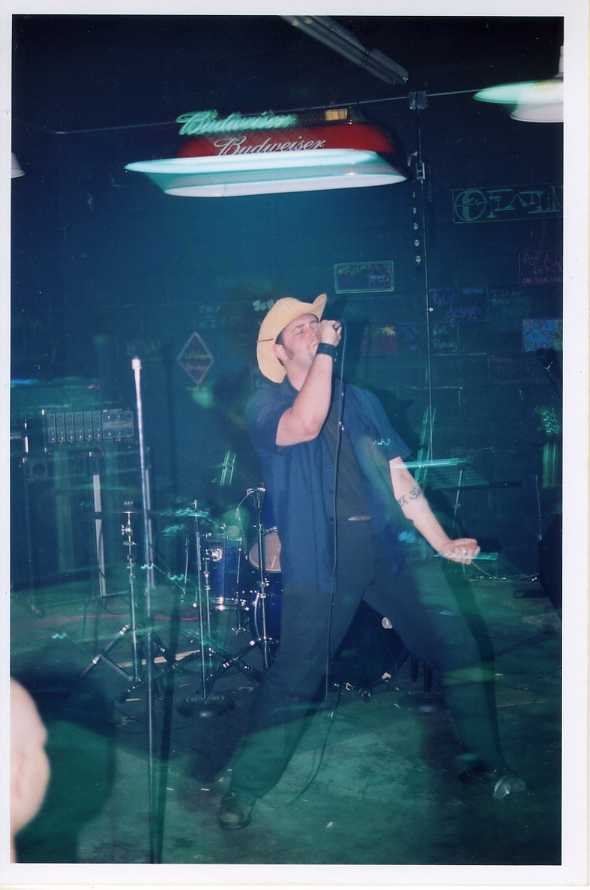
One of my tourmates at the Texas Blues Bar

One of my tourmates at the Texas Blues Bar, summer of 2002

You walk into the Texas Blues Bar and wonder if you’re gonna have to fight your way out. It’s that kind of joint. Two pool tables to your left, and in front of you is a long bar with twenty or so Texans sitting on barstools. All of them looking at you. It’s a row of mesh-back hats and blue work shirts, but these guys aren’t hipsters wearing thrift store clothes ironically. The work shirts have the right names sewn on the patch. The guys wearing them are wearing them because they stopped at the bar on the way home from work. You can just tell. And even the women around here look tough—not necessarily like they could kick your ass, but not necessarily like they couldn’t, either. But what can you do? Just keep walking like you know what you’re doing.

One of the pool tables is open. A guy is sitting on the stool next to the table. He’s got a pool cue in his hand. He’s looking for a game. It’s a good way to acclimate yourself to the crowd, so you head over there. Put two quarters on the edge of the table. Say to the guy on the stool, “Is this your table?”

He nods.

You say, “Wanna play a game?”

He nods again and stands up. He’s every inch a Texan: cowboy boots, tight blue jeans, camouflage T-shirt, and a fluorescent orange, deer-hunting baseball hat. He’s also about four feet tall. You’re not sure why that matters, but it seems to matter right now. Playing pool with a little guy just seems to make the evening perfect.

You drop the quarters into the slot, release the balls, and start to rack them. The little guy chalks up his pool cue. You say to him, “What are you up to tonight? Just having a beer on the way home from work?”

“Nah, man,” he says in a thick, Texan drawl. “I’m here for some readings. There’s some literature and shit going on here tonight.”

Any apprehension you may have been feeling wanes as soon as he says this. You are, after all, one of the guys reading. Bringing literature and shit. You smile and pull the triangle off the pool balls. “Should be cool,” you say. “Break ‘em.”

The pool game gets underway. The little guy isn’t very good, but can you blame him? He’s four foot tall and the table is three foot tall. Do the math: you’d have to find a pool table four and half feet tall to try to see things from his perspective. He doesn’t seem to care that he’s losing, though. He just wants to talk about punk rock and the bands he’s seen. He doesn’t tell any stories about the bands. He just says the name of the band and asks if you’ve heard of them. Like this:

“I saw NOFX,” he says.

When he doesn’t go on, you say, “Oh yeah?”

“Yeah,” he says. “You heard of them?”

“Yeah.”

Silence.

He does this several times. Sick of It All. You’ve heard of them. Strung Out. You’ve heard of them. Swingin’ Utters. You’ve heard of them. Lagwagon. You’ve heard of them. No Use for a Name. You’ve heard of them. Big Boys. You’ve heard of them. You stop him here. “Really?” you say. Impressed, because he doesn’t seem old enough to have seen the Big Boys. “You’ve seen them?”

“Nah,” he says. “I was just seeing if you’d heard of them.”

And so two pool games pass, just like that. The little guy has seen just about every band on the Fat Wreck Chords roster. That’s about all you learn about him. Well, that and that he’s damn proud of this accomplishment. And that he’s not very good at pool, but you learned that almost right away.

So you quit playing pool and wander around the Texas Blues Bar. You walk along that long bar. Your two tourmates are drinking at the far end of the bar. Before you make it that far, someone calls out your name. You turn and look. It’s the bartender/booker/manager, Roy. Roy is also your friend. He’s the reason why you’re in Longview, Texas. His shift must’ve just started, because he wasn’t behind the bar the last time you got a drink. You’ve been waiting for him, though, so you could figure out if there’s a drink special for the entertainers: i.e., you. Before you can ask, Roy hands you a Lone Star. You reach for your wallet. He shakes his head. So that’s the drink special: drink; you’re special.

Two guys who are obviously auto mechanics are sitting at the bar between you and Roy. They’ve got dirt and axle grease deep in the wrinkles of their fingers. They smell like hand cleaner. Roy points at you and says to them, “This here’s the guy who does Razorcake.”

“No shit?” says one of the mechanics. He’s wearing an American flag bandanna.

“Well, I’m one of the guys,” you say. “I mean, I don’t put it out by myself.”

“I love that fucking rag,” the bandanna guy says.

“Thanks,” you say.

“Listen, there’s something I want to ask you,” he says. He looks very serious. “Is Ian MacKaye gay?”

You almost say, “I don’t know. I never tried to fuck him.” But you stop yourself. No need to be a smart ass. The only problem is, if you don’t give a smart ass answer, you don’t have an answer at all. It’s never occurred to you to wonder whether or not Ian MacKaye might be gay. So you stick with, “I don’t know. Why?”

“Just wondering,” the guy says.

Roy tells you that the reading will start at around nine o’clock. It’s seven now. Roy assures you that everyone in the bar is there to see you guys read. There are also a couple of bands playing. The order is: reader, band, reader, band, reader. You’ve done enough shows to know that this is a recipe for disaster. But you don’t say anything, because you trust Roy and also because you seem to be in a place where the rules of the rest of the world don’t apply. So you just go with it.

sean_col_28

My tourmates dancing at the Blues Bar.


Nine o’clock rolls around. The Texas Blues Bar is packed and everyone’s drunk. There’s a room to the right of the bar that you didn’t see when you first walked in. It looks exactly like a two-car garage—big and open, concrete floors, no windows. The only thing missing is the garage door. This is where you’ll perform.

The poet you’re on tour with starts things off. It’s tough. There’s no stage. The first band’s equipment is set up behind him. And, even though the bar’s packed, only about a dozen people walk over to see the poet. He starts his act. You’ve seen him go through this ten times on the previous ten nights. You started the tour in Boston and have made it all the way down and around to here. You know word for word what he’s gonna say, how he’s gonna say it, when the crowd will laugh, when the poet will have the crowd hooked. Only, tonight, again, rules are off. He’s not getting the easy laughs. No one’s walking over from the bar to check him out. In fact, the crowd in this room is starting to thin. The poet cuts his set short.

This doesn’t bode well for you. You don’t read poetry. You have that going for you. But you do read short stories. Or, at least, you tell them. And the shortest of the short stories takes ten minutes to tell. If things go badly, you’re still stuck up there for ten minutes. And ten minutes can be forever when you’re bombing. You try to tell yourself that a lot of people here know Razorcake, so it may be better for you. But you know where Razorcake sells, and how many copies. The numbers just don’t add up. Still, you remember that you’re in a strange place. Rules don’t apply. Just ride it.

The band gets started. The lead singer is wearing a coveralls and a cowboy hat. He’s that weird kind of hybrid that you’ve been seeing all night: too punk to be a shitkicker, too shitkicker to be a punk. And that’s exactly what the music sounds like. And that’s exactly how the crowd looks. It’s a perfect fit. So perfect you get swept up in it. You get out onto that concrete floor and dance. Why not? Burn off some nervous energy. Get a good sweat going. Bounce into some Texans. Have fun.

Before you know it, the band’s done and you’re up.

Here you go. Bringing the literature and shit. Forty or fifty shitkicking punks are looking at you. You look back at them. It’s too late to wonder how it’s all gonna go now because it’s all going. You introduce yourself and tell a lame joke and someone to your left laughs like hell. You look at who’s laughing. It’s the little guy you played pool with. Game on.

You start to tell a story about working construction when you were a kid. It’s a more-or-less true story. You changed things to make it better, but you’ve told it so many times that you can’t remember what you changed and what’s real. The story is blue collar and it’s funny and sad. And so is the crowd. They seem to be digging it. They stay to listen, tipping Lone Stars, smiling, laughing sometimes when you don’t even expect it. The little guy is to your right with a big ol’ grin on his face. And you get to one part of the story. This is the hook. This is what you’re hoping will connect with the people around you. It’s the part where the narrator is hitting on a girl. He’s spent the day busting open a septic tank. He rubs the back of his head and finds a chunk of mud. You tell them that. The room goes silent. “Then,” you say into a sea of big eyes staring at you, “very slowly, I realized…”

And the first shout goes out. It’s the geeky chick who’s been hitting on every dude in the bar that night. She yells out, “No you didn’t!”

“Oh I did,” you tell her. “I realized…”

“Oh shit,” the little guy starts yelling. “Oh shit, oh shit, oh shit!”

“Tell it,” someone else screams. And suddenly you feel like you have a tent revival on your hands. They’re waiting for the punch line—hollering out encouragement, seeing what’s coming, even—and you can’t deliver it. Not yet. It’s all too right. The energy is too good. You have to feel it for a few seconds, at least.

But the seconds pass and you tell them, “I realized: that’s not mud.” The room goes nuts. This part of the story isn’t even that funny. At one reading on this tour, a girl even said, “Awww,” when you said this line. Like she felt sorry for you. Not these Texans, though. They hoot and holler. The little guy even slaps his fluorescent orange hat against his knee. Goddamn.

You keep going. You finish your story and someone even gives you an “Amen.” Amen.


Forty-five minutes later, after the second band has played and your second tourmate is halfway through his set, half of the room suddenly clears out. You have no idea why. Your tourmate is giving a hell of a reading. You’re enjoying it, and you’ve heard this stuff for ten days straight. Later, you’ll find out there was a fight in the parking lot. You’ll learn that one of the fighters broke the other fighter’s leg. You’ll spend a few hours wondering how someone breaks someone else’s leg in a fight. Spinning toe hold? Before all that, though, you’ll just kick back at your merch table and watch the room clear and be happy to watch your tourmate bring his literature and shit. You don’t need to see the latest spectacle. You’ve already gotten what you came for.


Author’s note: This is the seventh chapter to a collection of Razorcake columns I wrote.  It originally ran in Razorcake #28.  For more information about the collection, read this post.

Team Donofthedead

Illustration from Razorcake #50 by Brad Beshaw

Illustration from Razorcake #50 by Brad Beshaw

The Dogtown documentary doomed us.

Don scored us a couple of tickets for an advanced screening. There was a beautiful sense of excitement before the film, hanging out in the morning fog of downtown LA, standing in the very spot where Jon Fante starved and typed and wrote about starving and typing in Ask the Dust. And the documentary was good. A lot of cool, old skating footage, anyway.

That’s what Don and I talked about afterwards: the skating footage. We didn’t talk about the part in the movie when the filmmakers chose to show a map of Los Angeles and put a star on Paul Revere High School, thereby alerting filmgoers everywhere to the exact location of one of LA’s best kept secrets. The fuckers who showed the map were the same fuckers who talked about beating up anyone who gave away their secret skate spots. So be warned, Stacy Peralta: if I ever see you in person, I’m going to punch you in the head. Because, sure enough, the week after Dogtown and the Z Boys was released nationally, an eight-foot high fence was constructed around the Paul Revere parking lot, a twenty-four hour security guard was hired, and signs promising to arrest skateboarders were hung intermittently.

I wasn’t much of a skateboarder prior to moving to LA. I did have a skateboard. It was about forty-five inches long. When I lived in Cocoa Beach, I used it to ride down to the beach and check the waves. Sometimes, I’d ride it to a downtown bar or to the library.

The move to LA changed things considerably. For one thing, I was painfully poor that first year. Todd Taylor and I were trying to get Razorcake off the ground. Nearly every cent we had, we poured into the magazine. Nearly every cent we earned, we turned back into the magazine. One of the strange side effects of this poverty was that I started getting fat. The Mexican joint around the corner sold huge burritos for three dollars. And, when you’re surviving on about thirty bucks a week, six-for-a-dollar packs of Top Ramen seem like a good idea. So, yeah, you gain weight. Skateboarding seemed like a good way to counteract a cheese- and corn tortilla-heavy diet. The problem was, I was too poor to buy skating gear.

Don took care of this.

You may know Don as Donofthedead, a legend of the Razorcake record review section. But Don is more than a guy with fifteen thousand records in a back room in his house. He’s also the unacknowledged skating guru of Razorcake’s early days.

Don solved the problem of my longboard skate. He passed on to me a deck that allowed me to maneuver the high banks of Paul Revere without breaking my neck. I put my big, soft longboard wheels on that deck, and Don again took pity, scoring for me a set of harder, faster wheels. When he saw me fall one too many times, he passed on a set of camouflage knee pads, a little cracked on the left knee but nothing shoe goo couldn’t fix. When he ordered a pair of Vans that were too big for him, he passed them on to me instead returning them. Thus, I was inducted into Team Donofthedead.

In that first year of Razorcake, we skated Paul Revere nearly every weekend. Todd and I did. Don came along most weekends. Various other Razorcakers joined us occasionally. The first time I skated there with Don, he still had a cast on his wrist from a spill he’d taken several weeks earlier. At least I think he did. (If Don’s wife is reading this, then I stand corrected. Don never skated with a cast on his wrist.) Shortly after he got that cast off, he took another spill and broke the other wrist. He wouldn’t admit that it was broken. We had lunch at a noodle shop after the session. Don worked his chopsticks with fingers that were turning blue, just past a wrist that was swelling to three times its normal size.

Paul Revere was a great place to get back into skating. It was basically a parking lot cut into a hill. On three sides of the parking lot, the hill was paved going up about twenty feet. There was also a road coming in from a higher parking lot, so you could roll down the road and gather enough moment to ride up and down the hill as if it were a ten-foot wave. After about twenty yards of this, you ran into another paved, ten-foot high hill that you could roll up, kick turn, roll down, and ride the wave back to the road. It’s hard not to love a place like that. We showed it love in a way antithetical to the image of punk rock skateboarders. We brought push brooms and swept away the stones before skating. We picked up any trash that might be in our way. We left the place a little nicer than we found it. Then, that bastard Stacy Peralta made his self-aggrandizing documentary and Paul Revere was a bust.

Next, we started skating at an abandoned pool out in La Habra called the Jungle Bowl. It was a frequently graffitied spot. Whenever the skateboard wheels hit fresh graffiti, the surface would get slick and you’d slide. Sometimes this was fun. Sometimes, it was painful. We told Razorcake photographer Dan Monick about the spot—an abandoned pool cut into the high-priced hills of the LA suburbs, weeds and new growth taking over when a house had once stood and burned down, everything east to Riverside visible on clear days. Dan wanted to come with us and take photos. The spot was as picturesque as Dan pictured it, and he started snapping right away. Unfortunately for him, he expected Todd and me to be like those X Games skaters. The only time we caught any air, it was accidental and ended with a splat. Not great for photographs. Lucky for Dan, two other skaters showed up midway through the session. One of them was pretty amazing. He performed feats worthy of Dan’s camera.

We skated Jungle Bowl for a few months. I tried and tried without success to get enough momentum to carve above the pool light. I found a line that would get me just below it. Before I could find that new, perfect line, local high school kids started partying out at Jungle Bowl on weekends. Cops started noticing. The property owners repaired the break in the fence. They posted no trespassing signs. The cops added the spot to their regular patrols. Rumors circulated about skaters getting arrested. Jungle Bowl was a bust. We started heading to city skate parks.

Don taught me how to drop in at the San Dimas skate park. He taught me to power slide at the skate park in Whittier.

By this time, Razorcake was up and running a little more regularly. Money wasn’t quite as tight. We had a little leeway with regards to ad space in Razorcake, so we started making trades with Mike at Beer City Skateboards. I got a Duane Peters deck, wide trucks, new wheels, the works. I passed the deck that Don had given me on to Razorcake illustrator Art Fuentes. In that way, he joined Team Donofthedead.

For a while there, it seemed like I was spending a fair amount of time with Team Donofthedead. We hit a number of parks from Pico Rivera to Montalvo. The city of Duarte put in a new park right alongside the 210, and we explored a little less and skated there a little more. We spent a lot of time at the Whittier park, too, because Art lived around the corner from there.

Don was a little less stoked about the parks. He liked the hidden skate spots. One weekend, he and some friends hit an abandoned pool somewhere on the west side. He took a nasty spill and landed on his back. The next weekend, Don and I skated the park in Brea. Don took one spin around the bowl and decided to sit out the rest of the session. I took my turns, but mostly hung out and chatted with Don. He kept talking about the spill he’d taken. His back was still hurting from it. A week later, he had to have back surgery. His skating days were over.

Todd, Art, and I talked about this a few weekends later at Whittier: Todd with Don’s old trucks and wheels under his deck; Art with Don’s old deck and wheels; me with Don’s old knee pads and shoes. It was a sad moment. It was the real beginning of the end.

 *

The skate park in Upland is gnarly. It has a huge half-pipe going into a full pipe and ending in a bowl. You can drop in from the top or roll in from a four-foot-high ledge. I’d been having a good day rolling in from the ledge and riding the half pipe into the full into the bowl and back. Then, this old guy came along and started tearing shit up. He made dropping in from the top look so easy. I couldn’t resist.

Just before dropping in, I said to Art, “I don’t know why I’m trying this. It doesn’t matter if I can do it. It does matter if I break my arm.”

Art smiled.

I dropped in. It worked. I carved up and down the half pipe and thought, damn, this is fucking awesome. I made it into the full pipe with way too much speed. My trucks started wobbling. I tried an ill-advised power slide while about twelve feet up a wall, ended up taking the short cut to the ground and snapping a wrist bone in half.

Before my cast was off, Art blew out his knee at Whittier. Before Art could walk again, Todd broke his leg in two or three places at the park in Glendale. Team Donofthedead was done for.

Now, when I think about the early days of Razorcake, I think a lot about Team Donofthedead. I think about it mostly when I ride home from work and pass the new onramp, where a retention ditch has a road that runs alongside a bank paved into a hill. It looks like another Paul Revere carved alongside the freeway. I sometimes spend the last five miles of my commute imagining Team Donofthedead climbing the fence and riding that ditch in a world where cops won’t kick us out and our bones and tendons are young enough to take the impact.

These days, I mostly go surfing alone. Maybe it’s not quite as fun, but wipeouts are way more forgiving.

Author’s note: This is the sixth chapter to a collection of Razorcake columns I wrote.  It originally ran in Razorcake #50.  For more information about the collection, read this post.

Poisoning Schoolchildren and Other Patriotic Activities

sean_col_10_by_dan_monick

Photograph from Razorcake #10 by Dan Monick

With five minutes left to go in class, the principal came on the loudspeaker to tell everyone that a rocket had exploded, releasing a poisonous gas cloud. No one was allowed to leave their classroom until the poisonous cloud passed. So there I was – perhaps the world’s most reluctant junior high school teacher – stuck with thirty-five twelve-year-olds, waiting for a poisonous gas cloud to pass. Since there were only five minutes left in class, all of our classwork for the day was done. Since I was a first-year teacher in a horribly under-funded school, I didn’t have my own classroom. I roamed from one classroom to another during the day, bringing whatever books and supplies I could carry. This meant that, in case of emergency, I had no back-up materials: no games for the kids to play, no books with stories that I could read to the kids, no movies to show. Just to aggravate matters even more, when the poisonous gas cloud showed up, I was teaching in a football coach’s classroom. He had no back-up plan either. He once told me, “When kids get bored and act up in class, just make them do jumping jacks. It tires the little bastards out.”

The only thing I had going for me when the gas cloud floated overhead (and on any other day that I taught junior high, for that matter) was that I was big and mean-looking. I kept my head shaved pretty close to the scalp and I wore Doc Martens to school every day and a few of my students had seen me at an all-ages US Bombs show earlier in the semester, going nuts in the pit and doing shots with Duane Peters, and those students told everyone in the school about it. So I wouldn’t say that the students feared or respected me, but I could occasionally intimidate them.

The principal had said that the gas cloud would pass in forty minutes or so, so I figured I’d just move on to the next day’s assignment. I stood up and told the students to quiet down and open their books. I opened my planning book and glanced down at my lesson plans for the next day. Prepositions. Jesus, I thought, as boring as grammar normally is, this may be the most boring part of it. I launched into the assignment anyway, talking about how a preposition is anything you can do _____ a cloud. You know: in a cloud, underneath a cloud, surrounded by a cloud, etc. – which probably wasn’t the best way to explain it, what with the poisonous gas cloud above us. I talked for a couple of minutes, then asked one student to give me an example of a preposition. He said, “Who cares?”

“No, ‘who cares?’ is an interrogative statement,” I said. “Who can give me an example of a preposition?”

Stacy, a pretty intelligent smartass, raised her hand. I gambled that she might actually be taking a shot at the question and said, “Yes, Stacy?”

“Are we going to die?” Stacy asked.

“You’re getting closer,” I said, undaunted and acting naïve. “‘To’ is a preposition, but not in that sentence. When you say, ‘Are we going to die?’, the ‘to’ in that sentence is half of the verb form, ‘to die’, which is actually an infinitive. Who can use ‘to’ as a preposition?”

Stacy’s friend Kia raised her hand, and though I felt like it was futile, I called on her anyway.

“Are we gonna die, Mr. Carswell?” Kia asked. And when Kia asked the question, it changed everything. Because I knew Stacy was just trying to stir up some shit, but Kia was genuinely scared. And Kia had every right to be scared. There was a poisonous gas cloud floating by outside, and the only thing that separated inside from outside was the quarter-inch-thick glass windows. The windows were shut. They were sort of weather proof. Not a whole lot of poisonous gas could creep in, but still. Some poisons are pretty strong. It doesn’t take a whole lot to fuck you up.

As I thought these thoughts and weighed the options of what type of gas this might have been and how far away the rocket had been when it exploded and how real this danger really was, the absurdity of my whole situation struck me. All of these kids were freaked out by the cloud, and I was trying to teach them about prepositions. I closed my book. “I’ll tell you what,” I said to the class. “Take out a sheet of paper and write about this cloud that’s passing over us. Write about what you think it is, and why you think it’s up there, and what you think of Kennedy Space Center taking chances with your life by sending a rocket full of poisonous gas up into the air above us.”

Most of the kids took out a sheet of paper and started writing. I sat back down at my desk, keeping an eye on the kids and thinking about rockets. At the time, I was living in Cocoa Beach, Florida, which is the town I where I was born. One town over from Cocoa Beach is Merritt Island. That’s where I grew up. And on the north side of Merritt Island is Kennedy Space Center, which is where, among other things, scientists designed the rockets that went to the moon. So I grew up with rockets. They were nothing new to me. When I was a baby, my mom would carry me out to the front yard so we could watch the Apollo rockets head to the moon. As soon as I could walk, I’d go out to the front yard on my own to watch the rockets. After I learned to read, I started reading the newspapers on the day of a launch. I’d memorize the crews’ names and their missions and which rocket it was: Apollo or Skylab or the Columbia Space Shuttle. I’d even read up on the test launches and satellites. I tried to learn about everything that the Space Center fired up in the air. Of course, by the time I was twelve or so and my hormones kicked in, I’d completely lost interest in rockets. And, yeah, I’ve heard all the arguments about rockets just being an extension of men’s penises, or a metaphor for man’s desire to stick his dick into everything, even outer space, but by the time I was in junior high, the only penis I cared about was my own. So I stopped thinking about rockets and stopped going outside to watch them shoot up into the air and started focusing more attention on girls.

I looked across the classroom at my students. About half of them were busy writing on their papers. The other half had given up on the assignment, but they weren’t misbehaving yet. I watched Kia, who was kind of a punker in the sense that she wore black t-shirts a lot and dyed her hair crazy colors and was a free-thinker (well, for a twelve-year-old), but was mostly not a punker in the sense that her favorite band was No Doubt. The combination of her blue hair and the rocket that had just blown up reminded me of Angie Huber, a punker girl who I’d dated for about a week in junior high. Angie’s stepfather, a guy named Fred Haise, had been an astronaut. I only knew this because Angie’s mom always made a big deal about it. She’d always say his first and last name together, even though he was her husband, like everyone should know who Fred Haise was. According to Angie, though, he was just an asshole. The one time I met him, I could see her point. Not that he really did anything all that bad. He just criticized Angie a lot and looked mean when he did it. But Fred Haise had been on the Apollo 13 mission. He was one of the guys who had been in the rocket when they supposedly reported back to Mission Control, “Houston, we have a problem.” Then, of course, they made a Tom Hanks movie about the Apollo 13 mission, but I didn’t see the movie, and I never really did give much of a shit about Fred Haise. I did give a shit about Angie, though. I gave a shit about any girl who was goodly enough to make out with me behind some school busses when we were thirteen. I sat at the front of that classroom and thought about Angie and wondered what ever happened to her and if she still hated her stepdad and what she thought of that Tom Hanks movie.

I couldn’t do this for long, though, because the poisonous gas cloud was still floating over us, and most of my students had given up on their writing assignment. They were gradually working themselves up. It started with a few students talking quietly at their desk. I never did much to stop this, and I was too busy thinking about Angie, anyway, to stop anything. The talking got louder as they tried to hear themselves over the other voices talking. I made idle threats about sending them outside into the poisonous gas cloud if they didn’t shut up. My heart wasn’t into my threat, though, and the kids sensed it. They kept talking, and when it got too loud for them to hear the person who was three seats away and talking to them, they started to leave their seats and walk around. This was the point where, as a teacher, I was supposed to stand up and do something. Shut the kids up and stick them back in their seats. But I didn’t do anything. I’d always stopped them before they got to this point, and I was curious to see how far they would go. Pretty soon, more than half of my students were out of their seats and walking around, chatting with each other. Their voices echoed off the concrete walls of the classroom, and it almost seemed like a party. A few students even walked up to my desk to chat with me. I asked them if they’d seen Apollo 13. They said that they had, so I told them about Angie Huber.

“Which one was Fred Haise?” Laura – one of my pets – asked me. “Was he Tom Hanks or Kevin Bacon?”

“I don’t know,” I said. “I didn’t see the movie.”

“I think he was the other guy,” said Travis, another of my students. “I think Fred Haise was the funny looking one.”

“The one with the wife and the little baby?” Laura asked.

“I think so. Maybe not,” Travis said, and he was about to explain why Fred Haise might not have been the funny looking one when two kids started fighting in the back of the classroom.

I watched the two kids go at it, but didn’t do anything. Laura pointed out the obvious by saying, “Mr. Carswell, Billy and Glenton are fighting.”

“Yes, they are,” I said. I thought about getting out of my seat, walking across the room, and breaking up the fight, but decided instead to let it go. Billy had been asking to get his ass kicked for the past couple of weeks, and Glenton’s mom was a hooker. I figured it would do Billy some good to be humbled and it would do Glenton some good to let out some of his rage. Besides that, there was a fucking poisonous gas cloud outside. Deep down inside, I felt like all bets were off. I felt like, if society’s gotten to the point where Kennedy Space Center is sending poisonous gas into outer space in one of those great, big, explosive hunks of metal that they call a rocket, and if that explodes and that gas floats over me and the junior high school where I teach, and if the best thing they can do after sending that gas cloud over my hometown is to say, “Uh, you guys need to stay inside for a half hour until it passes,” then, obviously, this society has no rules. So fuck it all. Let ‘em fight.

The kids gathered around the fight, but no one stepped in to break it up. Glenton wrestled Billy to the ground and his fists rained down on Billy’s face. Billy managed to cover his face with his forearms. Glenton whaled on Billy’s forearms and ears and the side of Billy’s head. A few girls told me that I had to stop the fight. One girl started crying. Some of the boys cheered for Glenton or encouraged Billy. Most of the boys just watched. They seemed hesitant, as if they didn’t know whether or not they should stop the fight. Still, I did nothing. I let them fight. Part of me thought that surely another teacher would hear the commotion, rush into my classroom, and break up the fight. But, of course, that couldn’t happen because no teachers could leave their rooms and come into mine because there was a poisonous gas cloud floating through the halls.

Then, something strange happened. It was almost like a realization spread across the room. I think it started with Glenton. I think Glenton was on top of Billy, pounding his fists into Billy’s head and getting really tired when Glenton realized that I wasn’t going to stop the fight. And if I wasn’t going to stop it, no one was. And if no one was going to stop the fight, what was gonna happen now that he was too tired to punch Billy anymore? What was Billy gonna do? And if no one breaks up a fight, how does the fight end? I think Glenton realized this because he stopped punching Billy, got up, walked to his desk, and sat down. Billy stood up, too. His face was bright red and his hair and back were covered with dirt and debris. A paper clip clung to his cheek. He didn’t go anywhere for a few seconds. He just stood there, taking deep breaths. Then he, too, went back to his seat and sat down. The rest of the kids just stood around, not talking, not doing anything. Just standing there. Gradually, they all sat down, too. I can’t really explain it. Maybe they reached the end of their rebellion, and they had nowhere to go but back to the beginning. Or maybe I scared them by not breaking up the fight. Maybe they realized that, with the freedom to do whatever you want comes the responsibility to respect others, or else those others might kick your ass. Or maybe the fight just wore them all out like so many jumping jacks.

When they were all in their seats, Kia raised her hand again and finally asked the question they all should’ve asked right from the beginning. She said, “Mr. Carswell, if it’s so dangerous to everyone, why do they put poisonous gas in rockets?”

“Because the people at the Space Center – and the US government, too – take a lot of chances with our lives,” I said.

Kia nodded. She seemed to want to ask me more, but she didn’t. Justin picked up where she left off and said, “What do you mean?”

“Kennedy Space Center does all kinds of crazy stuff,” I said. “Have you guys ever heard of the Cassini Space Probes?” A few students shook their heads, so I explained that it was a rocket with plutonium in it. The class didn’t know what plutonium was, so I told them that it’s a radioactive substance. I also explained how dangerous it was for KSC to put a radioactive substance in a metal container on top of tons of very explosive fuel, then to set that fuel on fire. I explained how it was very different from, say, launching a nuclear missile, but the mechanics of the Cassini Space Probe and the mechanics of a nuclear bomb weren’t all that different.

Another student raised her hand. “I don’t understand,” she said. “I thought the Space Center just made the shuttle and stuff?”

“Oh no,” I told her. “Mostly what the Space Center makes is bombs.” This seemed to interest the kids even more than Glenton and Billy’s fight did, so I decided to go on that tangent. I told them that rockets were first made by the Nazis in World War Two so that they could kill a lot of people from a long way away. And that the top two Nazi scientists who developed the rocket bombs, Werner Von Braun and Dieter Huzel, came to America after World War Two and headed up the space program. I told them about all the different weapons they developed out at the Space Center, like various Inter-Continental Ballistic Missiles, nuclear submarines, and the SCUD missiles that the US Army used to kill a bunch of non-violent Iraqi civilians. And I just kept going. I was all worked up, partly because of that damn poisonous gas cloud, and partly because I hated the whole idea of the Space Center. It killed me that I had only two real employment opportunities in my hometown. I could either take a shitty job in an under-funded school, making lousy money and struggling to teach thirty-five twelve-year-olds about prepositions; or I could go out to the Space Center, where I would get paid twice as much to develop more efficient ways to kill as many people as possible from as far away as possible.

I knew that most of my students’ parents worked for the Space Center, and that I’d probably get into a lot of trouble when these kids went home and told their parents what I’d said in class. But I didn’t care. I figured that people who dump a poisonous gas cloud on their kids’ heads don’t have a lot of room to complain. So I went on and on about the problems with bombs and rockets and missile defense programs, and, for once, my students really listened to me. Not one single student talked while I talked. No one passed notes or kicked the kid in front of him or put trash from a spiral notebook into a young girl’s hair. They just sat there and listened and actually learned something useful.

Finally, the principal came back on the loudspeaker and told us that the poisonous gas cloud had passed. We were all allowed to leave our classrooms and go outside. I stopped talking and a few of my students actually groaned because they wanted to hear me slander the Space Center even more. I packed up my stuff, too, and got ready to head off to my next classroom and to teach my next group of kids. As I did this, I watched my students file out. And I thought, damn, these kids would be good students if the Space Center threatened to kill them every day of their lives.

Author’s note: This is the fifth chapter to a collection of Razorcake columns I wrote.  It originally ran in Razorcake #10.  For more information about the collection, read this post.
Memories of Murder in my Life

Illustration from Razorcake #37 by Brad Beshaw

Illustration from Razorcake #37 by Brad Beshaw

My brother had the big idea to make and sell “Free Jones Hand” t-shirts. Jones Hand was a guy I went to high school with. He sat behind me in an advanced algebra class. We weren’t friends, exactly, but we talked a lot. He signed me yearbook. “To a pal. Keep in touch,” he wrote. I think I only asked him to sign it because he asked me to sign his, and I didn’t want to seem like a dick. I remember thinking that Jones was a good enough guy, even if he did reek of booze most mornings.

A few years later, Jones had a psychotic break and attacked his Narcotics Anonymous sponsor with a hatchet. Jones cracked the poor guy’s head open.

When the news hit my hometown, most people acted stunned. I told them, “I blame the parents. Of course your kid’s gonna be a drug addict if you give him ‘Jones’ for a first name.” I rarely got a laugh when I said that.

My sister was shaken up by it all. She was friends with Charles Hand, Jones’s younger brother. Charles was rightfully torn up about all this. In fact, no one thought my brother’s idea about a “Free Jones Hand” t-shirt was funny. People responded to him with that long, slow, scolding “dude.” As in, “Duuuude. Not funny.”

I thought it was funny. I wanted one of those t-shirts.

I still kinda want one.

 *

I don’t even remember Ramon’s real name. He’d been in a high school Spanish class with my brother. Ramon was his Spanish class name. He was a suburban White kid like the rest of us. He worked at the Cinnabun in the mall. In those days, it wasn’t uncommon for my brother, my friends, and me to get a big soda at the mall, spike it with whiskey, and get drunk on the mall benches. This led to a lot of heckling. Ramon was often on the receiving end of this heckling. Nothing malicious. Just longwinded hoots of “Ramooooon” when he walked by.

Ramon was a tall, fat, sad guy. He’d shake off the heckles with a wave of his hand.

Our ability to heckle Ramon ended when Ramon killed a hooker under the 520 bridge. A buddy of his helped Ramon dispose of the hooker’s body. They both got caught.

*

Wendy was part of the whole crew I ran with back then. She was a sweet girl. There’s no other way to put it. She dated my brother for a while. Even my brother would say, “She’s too nice of a girl to date a guy like me.” They broke up after a couple of months. I don’t remember why. It wasn’t hostile or anything. Everyone remained friends. She was still part of the crew.

Wendy had a thing about birthdays. She always remembered people’s birthdays. On my twenty-third birthday, everyone forgot. My parents forgot to call. I worked all day with my brother. He forgot. No one at work remembered. My roommates didn’t remember. That night, we all went out drinking. Not to celebrate my birthday. Just because we drank every night. I ran into Wendy that night. She said, “Happy birthday.” She bought me a beer.

When Brian Zettle turned twenty-one, we all went out to celebrate. Since he actually didn’t turn twenty-one until midnight, we started the night at the restaurant where Wendy worked. Wendy brought us our first pitcher of beer and said to Brian, “You turn twenty-one tomorrow, don’t you?” Brian nodded. Wendy said, “Happy birthday.” She served us several pitchers before the ten o’clock closing time.

We all ended up at Spanky’s Pub. Wendy included. I drank a lot. Threw darts. Talked smack. Played songs on the jukebox. We all did. At midnight, Brian wanted to get his first legal drink at the strip club around the corner. I remember inviting Wendy to go with us, just to be polite. Very politely, Wendy said, “No thanks.” She was hanging out with a dude. For the life of me, I can’t remember what he looked like. Wendy introduced me to him. I shook his hand.

Later that night, after the rest of us had closed the strip club and stumbled drunkenly home, Wendy’s dude took the same hand that he’d used to shake my hand, wrapped it around Wendy’s neck, and strangled her.

Now, I think about Wendy every time I have a birthday.

*

Bart Staeger was one of my brother’s roommates in college. He got in a fight with a guy named Steve Austin—I’m not kidding about the name; it’s real—outside a bar in Orlando. Steve Austin punched Bart. Bart kicked Steve. Steve fell on the curb, cut open his head, and, because he was a hemophiliac, he bled to death. Orlando doctors did not have the technology. They could not rebuild him.

Bart’s one kick was renamed manslaughter and he was sentenced to five years in a maximum security prison. I heard he made parole in his third year.

 *

John Cox trained me when I started at the Groundhog Tavern. He showed me around a lot during my first days in Atlanta. He introduced me to a couple of other servers who would become lifelong friends of mine.

Back in those days, he dated this beautiful girl, Nikki. Nikki was pregnant with John’s baby. They were keeping the baby and would get married one day. In the meantime, John spent a good bit of time cheating on Nikki. Sometimes, he’d take his dates to the Groundhog. For some reason, he always sat in my section on these dates. I felt a little like I was cheating on Nikki when I served them.

I worked with John for a long time. I quit the Groundhog, moved to Arizona, moved back to Atlanta, worked with John again at the Groundhog. By this time, he was tending bar there. I never really drank at John’s bar, but a lot of hours of my life have been spent drinking with John.

The last time I saw him, a few years later, John had this huge abscessed tooth. It looked like he was smuggling a tangerine in his cheek. We played darts, did some shots, talked about old times. I’d like to say it was good to see John that night. Usually, it was good to see John. On this night, it wasn’t. John was all coked out and aggressive. I even let him win a game of darts, just to calm him down a bit.

I worried a little about Nikki and John’s five-year-old daughter.

At the end of the night, I told John, “Man, you gotta take care of that tooth. If that shit bursts inside your mouth and you swallow the poison, it’s gonna kill you.”

I don’t know if that’s true about an abscessed tooth. I wasn’t talking about the tooth, anyway.

A couple of years later, back in Atlanta, hanging out with one of those lifelong friends John had introduced me to, talking about all the old crew, I asked her about John Cox. Her eyes got big. “You haven’t heard?” she said. I shook my head. “Nikki was cheating on him and he couldn’t take it. He came home one night, shot her and shot himself.”

I couldn’t believe it. “They’re both dead?”

“No. He killed Nikki, but when he shot himself, it didn’t kill him. He’s paralyzed.”

“So he’s in prison now? Paralyzed?”

My friend nodded, big-eyed and sad.

“And the little girl?”

“Living with Nikki’s mom.”

 *

Tom Schwering was a shop teacher at my high school. One summer, I worked on a carpentry crew with him. The guy was kind of a hero to me. He was always giving me advice about dating girls, and the thing was, his advice actually worked. The year after I graduated high school, Schwering got shot in a botched coke deal. He survived. He lost his job at the high school, though, and moved back to his hometown in upstate New York. Rumor has it that he got shot in another coke deal in New York, and that time, he didn’t survive.

 *

And so on.

 *

I was tending bar at the Phoenix Brew Pub one night. At closing time, only three people sat at the bar: my manager, Glenn the brewer, and a guy named Kevin, who used to be my manager at the Groundhog. Since Glenn was part owner and everyone else outranked me, I let them help themselves to drinks while I did all the work of closing down. I hosed down the floor, dragged the bar mats into the kitchen, emptied the trash, wiped the bottles and the bar, counted out the bank and the tips, and everything else. Glenn, Kevin, and my manager kept drinking and chatting through it all. When I was done, I poured myself a beer and suggested darts.

We played several games, all with little wagers. Kevin won the majority of games and I won everything he didn’t. Glenn lost them all.

I should have noticed that Glenn was a sore loser. I should not have started teasing Glenn about the little man purse that he always carried around. And I absolutely should not have let the manager pull the bottle of Jagermeister out of the cooler.

Two shots of Jager, one more game of darts that I won and Glenn lost, and five or six more man purse jokes later, Glenn showed me what he carried in his man purse: a .45 millimeter pistol. A Glock. Glenn showed it to my by pointing it at my head. “Do you know what this is?” he asked.

“Put the fucking gun down, Glenn,” I said.

Glenn tried to make some kind of point. I have no idea what that point was. I didn’t even listen. I thought about all the lines of coke that Glenn and Kevin had inhaled off my freshly-wiped bar. I remembered someone telling me that Glocks don’t have a safety. I answered everything Glenn said by saying, “Put the fucking gun down, Glenn.” My manager and Kevin joined me in the chorus. Glenn kept talking. I kept looking down the barrel. I thought about Wendy and Ramon and Bart and Schwering and Jones Hand. I didn’t think about John Cox and Nikki because they were both still alive and walking at this point. Had they not been, I may have thought about them, too. Mostly, I thought about me and said, “Put the fucking gun down, Glenn.”

Finally, he put the fucking gun down.

I didn’t finish my beer or say a word or even pick up my jacket off the bar stool. I walked straight out the door.

Author’s note: This is the fourth chapter to a collection of Razorcake columns I wrote.  It originally ran in Razorcake #37.  For more information about the collection, read this post.

Celebrate the Ugly Things

Illustration from Razorcake #66 by Brad Beshaw

Illustration from Razorcake #66 by Brad Beshaw

They were the kind of coworkers who become funny in retrospect. Time has a way of turning tragedy into comedy. Though there was nothing tragic here. No one’s greatest virtue led to his downfall. It was more quiet than that, somewhere between time turning a pain in the ass into a modest chuckle and something more.

By the end of the summer, only three of us were left on the crew: Tweaker Bob, Aaron, and me. Tweaker Bob was the lead carpenter. In theory, we were supposed to do what he said, but he gave no instructions. He spent most of the day in the cab of his truck, flipping through three identical sets of blueprints for three identical tract houses in a row, all of which he was supposed to be working on. Now and then, a wave of inspiration would crash over Tweaker Bob and he’d jump out of his truck. I’m not embellishing here. He’d literally set his work boots onto the running board of his old Ford and launch himself out of the truck. He’d run to the bed, grab a saw and an extension chord, run to one of the houses, work furiously for ten or fifteen minutes, stop as suddenly as he started, and run back to his truck. He’d spend the next few hours there, studying the blueprints.

That wasn’t all Tweaker Bob did. Sometimes, he got in fights with total strangers in the Circle K parking lot. To hear Tweaker Bob tell it, the fight was always the stranger’s fault. It was always unavoidable. I didn’t point out to Tweaker Bob that fights in Circle K parking lots are almost always avoidable. In fact, most people avoid them for their entire lives. I didn’t tell Tweaker Bob what else I knew: if you encounter three assholes in a day, they’re probably not the assholes.

As you may have guessed, Tweaker Bob was not his birth name. The guy was six foot tall, weighed around 135 pounds, and had a teenager’s acne on his forty-year-old face. His teeth were beginning to rot from the outside in. He stayed awake for days at a time, then sometimes passed out in the cab of his truck in front of the job.

Bossman Bob was Tweaker Bob’s brother-in-law. He was somehow convinced that Tweaker Bob was not on crystal meth.

 *

Seventeen years later, these guys are back on my mind. I’m teaching a British Lit class. The assigned reading for today includes a Wikipedia page on John Milton. We’re discussing the benefits and shortcomings of Wikipedia. None of this has anything to do with Tweaker Bob and Aaron. Their lives don’t translate into encyclopedic knowledge.

One of my students, whose name is also Aaron, asks, “Did you used to be a carpenter?”

This may seem like a non sequitur, but I know exactly what has happened. Someone pointed out to him that there is a Wikipedia page about me. He’s switched over from Milton to Carswell, and now he’s checking to see how valid the information is. Whenever students ask me about being a carpenter or ask me how to pronounce my wife’s name, I know they’ve looked me up on Wikipedia. It’s not really a problem. I’m not even creeped out when, before I can answer, six or seven other students say variations of, “Yes. Didn’t you know that?” despite the fact that I have told no one in this class that I used to be a carpenter. This has happened before. I calmly redirect the class back to Milton’s role in the English Civil War. For the third time that class period, I stifle the urge to make a joke about Milton’s official title under Cromwell: Secretary of Foreign Tongues.

A student named Aaron asking me about being a carpenter is not what caused Tweaker Bob and the other Aaron to rise to the surface of my thoughts. The nine dollars I found in the pocket of my jeans this morning did.

 *

Now, the carpenter I worked with wasn’t really named Aaron. I changed his name for this story. Not to protect the carpenter Aaron. I’m not protecting anyone in the past here. Tweaker Bob’s name was really Bob and his brother-in-law, who was also our boss, was also named Bob. I’m really named Carswell. But I changed Aaron’s name because I didn’t want to call out my student, who really does share a name with my old coworker. So I thought about an equally white, middle-class-sounding name that would, hopefully, give you a sense of the ease and privilege the carpenter Aaron grew up in: that two story mini-mansion in east Flagstaff with multiple motorcycles in the garage and three expensive cars in the driveway, plus Aaron’s top-of-the-line Chevy Silverado 4X4. This work was a summer job for Aaron, something that his parents made him get to keep busy between semesters at Coconino Community College.

In some ways, Aaron was worse than Tweaker Bob. Violent and erratic as Tweaker Bob was, he usually stayed in his truck. The work he did when he left it was punch-list stuff, and he did a good job in his fifteen-minute flurries of activity. So he wasn’t helpful, but he wasn’t a problem. Aaron was a problem. Nearly everything he built had to be torn down and rebuilt correctly. Nearly ever cut he made was too short, and there’s no way to cut a board longer. I had to find ways to keep Aaron busy with jobs even he couldn’t fuck up. This was tough.

My favorite thing about Aaron: his tattoos. He’d made his own tattoo gun and started practicing on himself. He drew a Yosemite Sam on his left pectoral. The left half of Sam’s body was a full inch longer than the right half. You could only tell it was Yosemite Sam after Aaron told you so. He’d also made three attempts at the Tasmanian Devil. After drawing three blurred triangles—all of which Aaron claimed were the Tasmanian Devil’s tornado legs—Aaron gave up because it hurt too much.

 *

Even though I’ve now moved comfortably into middle-class life, even though I have a job with a salary and a pension, even though I live in an actual house now with my own actual washing machine and dryer, even though I could easily afford to buy several pairs of jeans, I still have only three pairs and I still wear them six or seven times between washings. That nine dollars—a five and four ones—lingers in my right front pocket. I walk through the halls of the university where I work, hands in pockets, feeling the soft bills rubbing gently against my fingertips.

 *

Like I said, everyone else on the crew had quit but Aaron, Tweaker Bob, and me. Aaron wouldn’t quit because he didn’t know enough to know things were fucked. There wasn’t a question of Tweaker Bob quitting. He was the reason the rest of the crew fled, and he couldn’t flee from himself. I needed one more week. After one more week, I’d have enough money to float by until the next semester started. Once that happened, I could go back to being a graduate assistant—the lowest form of teacher in a university, but an easier job than building tract houses for Bossman Bob and his tweaker brother-in-law. Only thing was, we were way behind schedule on these three tract houses. Someone had to get fired. I had a feeling it was gonna be me.

Here was Bossman Bob’s problem with me: I was a college boy. Worse than that, a graduate student. At least Aaron had the decency to be a community college student, and one who was years into working on a degree that he’d obviously never get. But I was taking post-graduate classes and teaching undergraduate ones. How could I be a carpenter, too?

As far as Bossman Bob was concerned, I couldn’t. Everything had to be my fault.

Lunch time that Friday came and went, and it was still just me, Aaron, and Tweaker Bob on the job. Aaron had smoked a little weed during lunch. When the break ended, he joined Tweaker Bob in the cab of the truck. I strapped on my tool belt and got to work. I’d stacked plywood and two-by-sixes against the garage eave. I brought my saw up to the half-finished roof and built the valley connecting the roof to the garage. I made all my own cuts while standing between the trusses. It was a precarious way of working and things moved slowly by necessity, but I liked having the time to work alone. I was in my early twenties then and had already spent nearly a decade working construction during summers and school breaks and even for a couple of years after getting my bachelor’s degree. Framing houses was comfortable for me, fulfilling.

The wind howled across the northern Arizona prairie. I kept one eye on the road to the west. As long as Bossman Bob’s truck didn’t come rolling up this way, I’d get my week. If I could just make it to two o’clock, Tweaker Bob would fold up the blueprints, holler out that he was going to pick up our paychecks, and split. I’d be safe.

Only Bossman Bob did show up. He brought his whole other crew with him. They spread out across the three houses, seven strong, working to finish these suckers off.

Aaron and Tweaker Bob teamed up on some living room walls. They were suddenly a tornado of activity. Bossman Bob sent two carpenters up to finish my work in the valley. He had me to build interior walls. All simple and easy. Everyone worked in teams of two but me. No one said anything to me. I could feel the target on my forehead. I kept an eye out for daylight. If we could just stretch this sucker to sunset. Every extra hour I could clock in before that bomb dropped would mean another nine dollars of groceries to get me through the summer’s end.

Saws whirred and hammers pounded until seven-thirty that evening. The houses weren’t finished by then, but they were close. While everyone else rolled up extension cords and packed away tools, Bossman Bob said to me, “We have to talk.”

“What’s up?” I asked, though I knew.

“Well.” Bossman Bob looked west across the prairie at the fading evening sun. “I’m gonna have to let you go.” He started to explain why, but I didn’t stick around to listen. No point in that.

 *

Now, I can see why it’s tough for someone to imagine I was a carpenter once. When I was young and tan and blond and carrying around over two hundred pounds of muscle from a heavy-lifting job and fat from lunches of Circle K hotdogs, it was easy to tell what I did for a living. Now, I’ve dropped at least thirty of those extra pounds. I iron my work shirts. I eat a lot of vegetables. Unless you catch a glimpse of the scars on the backs of my hands or the sunspots lingering on my skin, it’s hard to tell I was anything but a guy who got paid to talk about John Milton’s role in the English Civil War.

 *

A week after getting fired, I went back to the jobsite to get my final paycheck. Bossman Bob met me at his truck and gave me the check. It was nine dollars short. I needed that nine dollars. I had two weeks left before the start of classes, three weeks before my first grad assistant pay came in, and only about thirty-five dollars left over. Rent and bills were paid. I could get by. Money had been this tight before. I knew how to eat on twelve bucks a week. Still, nine dollars meant something.

In the week that I’d been gone, Tweaker Bob and Aaron had done no work. Bossman Bob was starting to see his mistake in firing me—the last guy who was actually working on the crew. He wanted me to explain the situation. I said, “This check is nine dollars short.” Bossman Bob asked more questions. I tapped his checkbook. “Nine dollars.”

Bob wrote the check, but he wouldn’t stop grilling me. I wasn’t about to say anything to get Tweaker Bob and Aaron fired. I had nothing against them. They weren’t to blame. I was. I could’ve defended myself before I got canned. I could’ve called Bossman Bob up weeks earlier and explained the situation and tried to get on a different crew or something. I could’ve done more than just working silently and waiting for the axe to fall. So I didn’t blame anyone but myself. I made my mistakes and took the consequences and that was that, as far as I was concerned.

But I needed that nine-dollar check. It was under Bossman Bob’s hand and he wasn’t giving it up. Finally, I feinted a punch toward Bossman Bob. I had no intention of hitting him. I just didn’t know what else to do. Bob flinched, lifting his hand off the check. I grabbed it and headed toward my truck.

I was in the driver’s seat with the engine running before Bossman Bob recovered and started yelling at me. Part of me wanted to turn off the ignition, to get out and do what every working class man in America dreams of: fight my boss. The rest of me knew, though, that I needed to get to the bank before he changed his mind about these checks.

*

Back here in the present tense, I know I can keep that nine dollars in my jeans indefinitely. Maybe not the same nine dollars in the same pair of jeans, but a never-ending nine dollars forever in excess of anything I need. It can serve as a talisman against a time when, if I’d found an extra nine dollars in my jeans, I’d have to spend it. If not on food or some other necessity, I’d have buy beer or weed or something to help me escape the world where nine dollars meant so much to me.

Now, that money can be a gift to the young carpenter living inside me. Others may need Wikipedia to see him. I always know he’s there.

Author’s note: This is the third chapter to a collection of Razorcake columns I wrote.  It originally ran in Razorcake #66.  For more information about the collection, read this post.

The Second Sunrise

Illustration from Razorcake #67 by Brad Beshaw

Illustration from Razorcake #67 by Brad Beshaw

It doesn’t really matter why I was in that bar just past noon on a weekday. Whatever reason I give will just be an excuse for living out a self-destructive life. I don’t know what that guy was doing in the same bar at the same time. He probably had a different excuse.

We were more or less the only two in the joint. There was a bartender. She sat as far away from us as possible, reading some glossy magazine full of celebrity gossip. There was a television, too. It flashed lights and people on it talked about something we were supposed to care about—sports or politics or something. At least the volume was low enough to ignore.

I’m not sure what that guy said to get us started talking, but I was okay with it. I like talking to strangers. I like hearing their stories. I didn’t expect much out of a skinny, middle-aged, white dude nursing beer in a bar called Bunhuggers. But what the hell? I might as well listen to something.

The guy told me a story that I’ve carried with me ever since. It’s like a lucky stone in my pocket. The oil from my fingers seeps into the pores of it. I’ve long since rubbed it smooth.

 *

The guy was in the National Guard in the seventies, he told me. His father had known some people and pulled some strings so that, when his time came to serve, he didn’t have to go Vietnam. Instead, he signed on with a crew of medics stationed somewhere in the northeastern United States. It was an easy gig until they got sent to Iceland.

This was in late 1972. The navies of Iceland and Great Britain were perched on the edge of open hostilities, about to start shooting each other over cod. See, Iceland is an island mostly composed of volcanic rock. The soil is far from fertile. Winters are long. Farming is tough. The rest of the island isn’t exactly overflowing with natural resources. There are a lot of fish around the island, though. A lot of Icelanders make their living as fisherman. A lot of Icelanders’ diets are seafood heavy.

In the early seventies, that fishing industry was threatened, mostly by fleets coming over from the Soviet Union. Russian trawlers were dropping big nets into the ocean near Iceland, scraping up everything in their path—fish, vegetation, rocks, entire ecosystems—and dumping the whole catch into the freezers of their factory ships. It was devastating Iceland’s way of life. In response, the Icelandic government declared that the ocean within a fifty-mile radius around Iceland was an “exclusion zone.” No one could fish in it except Icelanders.

The Icelandic navy attacked anyone who violated this exclusion zone, but their attacks were non-violent (unless you’re one of those people who interpret the destruction of property as violence). The navy would charge fishing boats and cut their nets with sharpened grappling hooks. The nets would drift harmlessly to the bottom of the ocean. The crews would turn and head back to their home port. Fishing nets were expensive. Fleets were likely to continue losing the nets on subsequent trips, so most fisherman recognized Iceland’s exclusion zone and went somewhere else to catch their cod. The only fishing boats that kept coming were British fleets.

It was all about fish and chips. It’s a British staple, part of the whole cultural identity. They had to get the cod for the fish and chips somewhere. Iceland was that somewhere. So Great Britain sent a couple of battleships into the exclusion zone to protect the fishing fleets. The Icelandic navy responded by cutting the nets off the fishing boats. Great Britain threatened to attack with their battleships. The Icelandic navy—which, keep in mind, was not a heavily-funded navy; it was mostly just little fishing boats rigged with whatever guns were handy—fired a warning shot across the bow of the battleship. It was David showing his slingshot to Goliath. NATO stepped in before things escalated.

The dude from the bar was part of the NATO forces. He flew into Reykjavik with the rest of his unit. They sat around eating cod for a few weeks while the British battleship and Icelandic gunboats looked down their scopes at each other and diplomats tried to find a way to keep them from shooting.

This was wartime for the privileged white sons of upper-middle-class America.

Then things exploded. Or, to be more specific, Helgafell and Eldfell exploded.

Helgafell and Eldfell were volcanoes thought to be dormant. They sat on the little island of Heimaey, just off the southern coast of the main island of Iceland. A seam had developed on the edge of the volcanoes, running through both of their cores. Lava and ash began to actively flow. The problem with this was the little fishing village of Vestmannaeyjer, which sat about a mile away from this now-active volcano. About five thousand people lived in Vestmannaeyjer. The dude and his National Guard unit were sent in by helicopter to evacuate them.

The dude flew in at daybreak. What he took at first to be the sunrise was actually the volcanic seam erupting. The sun crept up minutes later, farther south. The helicopter flew between the two sunrises, into Vestmannaeyjer. Only, when they got to the town, many of the locals refused to evacuate. This was a remote village on a remote island in a remote country. If the villagers got on the helicopters, they would leave behind everything. Their homes, all their possessions, their whole village, would be swallowed by the volcano. There’d be nothing left. And where would they go, then? The same lava and ash would have the same effect on the homes and possessions of all of their families and friends. So it wouldn’t just be a case of individuals losing everything. It would be a case of individuals and everyone they knew losing everything. So they decided to stay and fight the volcano.

Of course, they had no established plan to fight the eruption. How do you put out a volcano? Spray water on it?

Well, this is exactly what the villagers did. They rigged up water pumps and hoses and pipes—all told 43 pumps and over 19 miles of pipes and hose—starting at the harbor and stretching into town. They dipped one end of their fire hoses into the Atlantic and pumped that water through the pipes and hoses. Some crazy villagers stared down the lava flows, spraying water on them. Of course, they knew they couldn’t put out the volcano the way you put out a fire. The idea was to cool enough lava to build a rock barrier at the edge of town. This way, the lava would bank off the barrier and flow down into the uninhabited parts of the harbor.

The dude and his buddies in the National Guard thought this was madness. They took what evacuees they could back to Reykjavik, left them in makeshift shelters, and flew back into the sunrise that lasted all day. The villagers kept at it for days, working in the air thick with burning ash, turning lava into rock. They didn’t stop until they’d redirected the flows into the sea. It took them more than 8 million cubic yards of ocean water to do this. When they were done, about two-thirds of the town was saved.

The other third of the town was buried in what was by now rock. The dude walked down the street, past roof tops setting on the new ground. He tripped over the top of a stop sign, now only ankle high. He had no idea how to make sense of what he’d just seen.

*

This was the story the dude told me in Bunhuggers. He didn’t tell it the way I just did. It took a lot of time for me to get all the details. I wanted to believe him, but to do that, I had to ask dozens of questions, get him to fill in all the details of a standoff between Iceland and Great Britain, of rigged up fire hoses and the motivations that drove that courage or madness or whatever you want to call it. I was fascinated when he told the story. When he was done, though, I was mad and a little sick.

 *

Years later, I told the story to Heela and Shahab from Geykido Comet Records. We were at a show in LA, chatting between bands. Heela wanted to know if the story was true, if there really was a standoff between little Icelandic fishing boats and a British battleship, if a village really did stand up to a volcano. “I don’t know,” I told her. “I never looked it up because I’d be too disappointed if that dude was lying.”

Heela was more courageous than me. She did a good ol’ Google search, then sent me an email that said, “I would have kept this a secret if it weren’t true.” And, sure enough, both events occurred in 1973. A dozen websites and a National Geographic article will attest to it.

Shahab took a more critical approach to the story. He said, “You should write that story, only take yourself out of it.”

My apologies, Shahab, but now I’ve written that story. I kept myself in it. I even dragged you in it with me.

See, carrying this story around as long as I have, it’s become mine. Not that I’ve ever been to Vestmannaeyjer and seen the chimney tops that could bruise my shin, not that I could have possibly been in Iceland in 1973 and been a part of this whole scene. But when that guy told me that story, it changed me a little. It forced me to consider what I really valued in this life. I knew then and know now that there’s nothing I would stand in the face of a battleship to protect. But what about my way of life? What about my life and village and family and friends and community? Could they possible be less valuable to me than they were to the people in Vestmannaeyjer? If they aren’t less valuable, then what was I doing drinking alone at noon in a shitty bar? Is there a constant threat of eruption above me, in places that I thought were dormant? Does metaphoric lava forever flow toward me? Does it mean anything?

I carry this story around with me not because I’ve found the answer to these questions, but because it forces me to ask them.

Author’s note: This is the second chapter to a collection of Razorcake columns I wrote.  It originally ran in Razorcake #67.  For more information about the collection, read this post.
Same Thing We Do Every Day: Try to Take Over the World

Illustration from Razorcake #69 by Brad Beshaw

Illustration from Razorcake #69 by Brad Beshaw

The Beatles song “Back in the USSR” played over the speakers at a gas station. Maybe because the car stereo was broken and we were taking this trip without tunes, I was susceptible. I can usually block out the music in public places. Even when I can’t, I keep certain catchy songs in my mind. This way, if I hear something I don’t like, I play the catchy song I do like in my head and get the other one out of it. It’s a good trick for fighting the tyranny of store stereos. But my defenses were down. “Back in the USSR” rode an earwig into my brain and got stuck on repeat there.

I’m not a Beatles fan. I could live a happy life without ever hearing another Beatles song. I doubt that I’ve ever listened to them voluntarily, though I know all the words to dozens of their songs. My parents were big Beatles fans. They played the hell out of a two-volume Greatest Hits album. They had it on eight-track, and because it was a double album, I spent much of the early eighties hearing all sixteen tracks of this collection. “Back in the USSR” was on it. Hearing it again after years of avoidance, getting it stuck in my head, sent my mind down a long-abandoned neural trail to a memory that came from another world.

 *

Somewhere around 1981, I was in an elementary school program called “Gifted.” It was set up for kids who did well on an “intelligence” test. I put gifted and intelligence in quotes because something had to be wrong with that test. Only white kids tested into Gifted. Originally, only white boys tested in. After one year, a couple of girls passed the test and joined us. Us boys were not happy about this development, especially considering the cootie epidemic that had run rampant through our elementary school for years. We became more accepting of the girls, though, as we got older and closer to puberty.

Even though more than a third of the students at my elementary school were African American, no black kids were deemed gifted. This suggests to me that either there were no intelligent black kids at my elementary school or that the intelligence test was designed to privilege the experience of one race of kids while denying the experience of another race. You pick which option aligns more with your world view.

Us gifted kids were bussed to another school on Fridays. We took a variety of classes there. The class sizes were smaller. We got to choose what we studied. We were taught by teachers who had worked their way into the gifted program, who had paid their dues and won their awards and earned a spot teaching a small group of motivated, studious, well-behaved kids. It was the best part of the week for us.

In 1981, I signed up for a gifted course called “World War.” It was mostly a geography class. Our teacher explained on the first day that we would form groups of four. Each group would create our own country. We’d name our country, decide who in the group held which office, amass points based on the work we did over the course of the semester, and, at the end of the semester, battle other countries with our points. Whichever group won those battles ruled the world. I teamed up with three other white boys and ran for president of our little country. I won for a couple of reasons. Maybe the biggest reason was that I was the only kid in the class who had to learn how to fight growing up, so while I certainly wasn’t the toughest kid in my elementary school, I was the toughest kid on the gifted bus.

I know that being the toughest kid in Gifted is like being the smartest kid in the dumb class. Fuck it. I got to be president, anyway.

We wanted to name our country the USSR. Not because we were budding Bolsheviks. Because we grew up near Kennedy Space Center during the Cold War. For us, USSR would stand for the United States Space Race. We were reclaiming USSR for ourselves, for America. Our teacher, whose name wasn’t Mrs. Arrien but I’m going to call her that because it sounds just right if you read it out loud, told us we couldn’t do it. We dropped the “States” and became the United Space Race. One of us got cracking on the logo immediately.

Since it was essentially a geography class, our country earned points by doing projects on foreign countries. We’d have to write reports on where other countries were, how they made their money, who their leaders were, what their culture was like, and things like that. Luckily, we had one boy in our group who was really into that kind of thing. For some reason, he loved to write and research things. While most of the group goofed off in the library, this one kid actually read all about different countries and wrote a bunch of reports. He didn’t just use the encyclopedia, either. He asked the librarian for help and found a bunch of books. He read them and took notes. He wrote stories set in those countries for extra credit. Mrs. Arrien also gave him props because he was the only kid in the class who could answer the question, “What are the customs of Germany?” correctly. The rest of the class had just assumed that Mrs. Arrien had forgotten the “e” on costumes. They talked about lederhosen and shit.

Now, was this geeky kid who did all the work for the USR the same geeky guy writing this column?

You bet.

I’m still fascinated by geography. I often read books in translation, study the news of the world, and embarrass my wife when she introduces me to her Bulgarian friend and I start talking about Hristo Stoichkov and my desire to travel to Sofia someday. I can even tell you the names of the leaders of faraway, exotic places like Canada. It’s the Right Honourable Pierre Trudeau, right?

So anyway, as president of the USR, I pooled all my brainiac strength. Our country amassed a point arsenal that was nearly enough to overpower all the other groups in class at once. The day came for our world war—the whole point of the class. Mrs. Arrien explained the rules. Two countries would face off. Each country would bring enough points to the battle to win. Whichever country had the most points won the battle and kept all their points. Whichever country lost had to sit quietly and sulk like a bunch of losers. The residents of the USR were cocky. We knew we had way more points than the other groups. We brought all our points to the first battle. The other country, the Jedi, were quaking in their boots. We knew we’d destroy them because they weren’t even smart enough to name themselves something cooler, like the Rebel Alliance or something. We laid our heavy load of points down on the table and said, “Bring it on.”

Mrs. Arrien asked us if we were sure we wanted to do that.

As President of the USR, I said, “Of course.”

Mrs. Arrien said, “Countries can form alliances. They can team up, pool their points, and defeat more powerful countries. You know that, don’t you?”

No. We did not know that.

And now it was too late to change. All of the other countries had seen how many points we had. It was almost, but not quite, three times as many points as the other countries had. So the Jedi teamed up with the Islanders (named after Merritt Island, the town we all lived in) and Vader (named after the disposition of their evil leader). They found enough points to beat us. The USR, my presidency, ended there. My other group mates cursed me. The failure was all my fault. I pointed out to them that I was the one who earned all the points, anyway. “Fat lot of good they did us,” someone said. I was sunk.

Angela Whitman, the president of Vader, outplayed the other two countries. While they were pooling their points, she casually asked each group how many points they each had. The other kids hadn’t quite figured out that the key to winning the game was to not let anyone know how many points you had. They spilled the beans to Angela. After the three of them defeated the USR, Angela allied Vader with the weakest country (the Islanders). Together, the took over Jedi. As soon as they did, Vader turned on the Islanders and crushed them. For the rest of that class period, Angela Whitman ruled the world.

I sat in the corner and wore a funny hat. Maybe not literally, but that’s the way I remember it.

 *

A few decades later, driving north up Highway 101 with “Back in the USSR” lodged in my brain the way a torn fingernail gets lodged between your teeth, I thought back to my old presidency. I’d like to say that Angela Whitman went on to become the corporate raider that World War taught her to be, but she didn’t. She got pregnant the summer after high school. Last I heard, she was still a stay-at-home mom. I didn’t use her real name in this story because I didn’t want anyone looking her up on Facebook and seeing the pictures of her youngest daughter graduating from high school. At least that’s what I assume you’d see. I don’t have a Facebook account. I can’t see who from my childhood got fat, who hates their job and always posts that it’s humpday on Wednesdays, who’s divorced and trolling, or who “likes” what. I’m in contact enough to know, though, that no one from the old gifted days amounted to much. Our training in taking over the world never really panned out. Just as, fifteen years ago, I came to terms with the fact that I’ll never be a professional athlete, I can now come to terms with the fact that I’m too old to start on a path toward dictatorship and world domination. It’s okay. I wouldn’t want to be a pro athlete or a tyrant. I’m okay being who I am.

I wonder, though, about the long-term effects of my upbringing. Obviously, classes like World War and programs like Gifted taught some troubling values to me as a little kid. They instilled in me an ideology of tyranny and white supremacy before I was old enough to do much critical thinking. My defenses were down. I wonder how much of that ideology is still stuck in my mind like a silly Beatles song.

And, because my childhood wasn’t unique for a kid in America, I wonder how much the ideologies are stuck in all of our minds.

Author’s note: This is the first chapter to a collection of Razorcake columns I wrote.  It originally ran in Razorcake #69.  For more information about the collection, read this post.
Mythologies for the Marginalized

I gave birth to an ugly baby. His name is Razorcake. He comes around every two months. As one of his two biological parents, I still beam every time I see the ugly little bastard.

sean_illo_60_by_brad_beshaw

Illustration from Razorcake #60 by Brad Beshaw

Sure, we got parenting advice along the way. “Give him some color,” people told us, but we raised him to have muddy, black-and-white pictures on inky newsprint. They cried, “Put in a letters section.” But, no. If our readers want to have their say in print, they either have to take the time to write a feature for the magazine and submit it, or they have to start their own zine. Distributors kept telling us, “Put photos of sexy young punk girls in the magazine, especially on the cover.” We didn’t. If any scantily clad bodies showed up on the cover, they were sweaty, fat men who repelled more readers than they attracted. Razorcake giggled with us when those distributors went out of business, and he was still around, ugly and inky and obstinate as ever.

The biggest advice I heard was that I’d outgrow Razorcake, that I couldn’t put out a punk rock zine forever. And I’ve grown, sure. I’ve gotten older and grayer. I’ve held a day job for almost a decade, now. I got married. I no longer spend my days among the swarms of termites in a rundown two-bedroom apartment in Highland Park, turning up the music to drown out the sounds of ghetto birds and gunshots, putting together the latest issue of Razorcake. We moved Razorcake Headquarters to a basement a few blocks away. It’s much nicer. No one’s car gets tagged when they come to visit, anymore. A middle school works as a shield between the HQ and the gang activity that used to surround us. And, as for me, almost all of what I used to do has been taken over by volunteers. Let’s face it: they do a better job than I ever did.

Still, rather than me outgrowing Razorcake, it seems to have grown up with me. I’d say that about punk rock, too. When I was a kid and still listening to the Sex Pistols without irony, I believed Johnny Rotten when he sang about us having no future. I internalized it. I never could’ve imagined how far punk rock would go and how far I’d go with it. I didn’t realize how empowering the do-it-yourself ethos could be. But when I got frustrated with the mainstream media, I knew I could start a zine that countered it. When book publishers seemed to be rejecting my favorite writers from the punk rock underground, I started a new publishing company designed to give these writers a voice. When the scene around me got stale, I set up shows and readings and sometimes even tours. I stayed involved. Rather than outgrowing punk rock, I learned to develop a way of looking at the world that comes from spending much of ones adolescence and all of ones adult life immersed in punk rock.

I think we all have a lens through which we see the world. We construct an ideology, of sorts, and it brings into focus the events and cultural stories that surround us. Because my day job sees me teaching English at a state university, because I have a doctorate in literature and criticism, I’ve been trained to call this lens or ideology “theory.” I recognize that, over the past twenty years or so, I’ve developed my own punk rock theory. And, like a true parent, I’ve thrust this theory on my ugly little child, Razorcake.

My biggest contribution to raising Razorcake these days is my regular column. It’s titled “A Monkey to Ride the Dog.” Regardless of what’s been going on in my life, regardless of how busy or broke I’ve been, beyond anything else I’ve sought to accomplish or do with my life, I’ve sat down for several hours every two months and written a column for Razorcake. I give those several hours priority despite everything. Sometimes, this seems ridiculous to me. These columns are just eighteen hundred words for a punk rock rag. Most likely, my audience is taking a dump while he or she reads my column. And mostly the columns are simple stories from my life. Often, they don’t address punk rock directly. Sometimes, they don’t seem to have a point at all.

Collectively, though, these columns provide a way of looking at the world beyond the typical mainstream stories that clutter our lives. They are, in a sense, a punk rock theory.

One of those great books that English professors like me like to read and reread is a collection of essays called Mythologies by a guy named Roland Barthes. Mythologies gathers up columns that Barthes wrote for a literary journal in the 1950s. Barthes applies linguistics to popular culture. When I read it, I’m struck by how each essay, when taken on its own, seems to be dated and maybe even a little irrelevant. I like that he’s talking about, say, professional wrestling and linguistics, but the professional wrestling he discusses has nothing to do with the pro wrestling I’m familiar with today. Instead, what makes the book so powerful is that, after reading all these essays about a pop culture that doesn’t really exist anymore, I’ve learned how to look at popular culture today through Barthes’ eyes.

In a sense, this is what I hope to do with A Monkey to Ride the Dog as a collection. It’s a kind of Mythologies for people who still like their music fast and loud. I don’t think these essays are dated. They will be in fifty years, sure. For right now, they’re okay. They discuss a world we can recognize for at least the rest of this generation. And when these essays are taken together, hopefully they’ll help you, as a reader, to see the world through one punk rocker’s eyes. Hopefully, they construct a punk rock theory that may be useful as you get old and gray like me, as you move into the world of middle age but still search for a way to reject the incessant and vacuous culture that consumer capitalism thrusts down our throats constantly.

Author’s note: This is the introduction to a collection of Razorcake columns I wrote.  I wrote this originally sometime in 2012.  For more information about the collection, read this post.

A Monkey to Ride the Dog

sean_illo_45_by_brad_beshaw

Illustration from Razorcake #45 by Brad Beshaw

I recently submitted my eightieth column for Razorcake.  It seems incredible to me.  Eighty columns.  One every two months for thirteen years, four months.  For a punk rock zine.  Weird.

On the other hand, I feel differently about my Razorcake columns than anything else I write.  They are the only things I reread once they’re in print.  Or, I guess I should be more specific.

When I write novels or short story collections, I’ll read specific chapters or sections from the book after it’s published.  I’ll read these sections for a reason, though: to prepare for a performance or to fact check something.  I’ve never read one of my books all the way through once it was in print.

When my short stories run in literary journals, I frequently read everything in the journal except for the story I wrote.  When I write reviews or essays for various publications, I never look back over them in print, mostly because I revise short stories, reviews, and essays so incessantly that one more reading of the piece seems excessive.

But the Razorcake columns: I reread those just for fun.  Every two months, there comes a time when I’ve read the rest of the issue and I’m not ready to wait for the next one, so I sit down and reread my column.  I love those moments.

A couple of years ago, I decided to put together a collection of my favorite columns and submit it for publication as a book.  I went back through the first twelve years of columns, picked my top twenty-six, and wrote an introduction so that they’d make sense as a whole.  I intended to send it out for publication.  In fact, I did send it to an editor I know who works at a publishing house I respect.  He told me that he loved the columns individually, but when you put twenty-six of them in a book, it doesn’t work.

I felt pretty much the same way.  I was ambivalent about even sending out the collection.  When an editor I respected echoed my feelings, I decided to shelve the collection.

The columns were meant to be read one at a time.

With the eightieth column, though, I decided to unearth the collection and post it here.  Not all at once.  That doesn’t work.  Twenty-six consecutive columns is overwhelming.

Instead, I’ll post one column every other Tuesday.  This will start next Tuesday.  When they’re all live, I intend to return to this post and create a series of links so that you can find the whole collection in one place.

A note on the columns:

The columns in this collection are arranged in a more or less chronological manner according to when the events in the column occurred (not when the column was written). Outside of changing a few things we missed in the first round of proofreading, the columns are the same as the ones that ran in Razorcake. I edited nothing from the perspective of an older and wiser writer. I chose not to include several early columns because the best of them ran in my collection Glue and Ink Rebellion. I’m slightly ashamed of the poor quality of the rest of them. For that reason, most of the columns in this collection ran in Razorcake between 2005-2012.

If I thought that the real people involved would be embarrassed or put out by what I wrote, I changed their names. If I thought they’d be stoked or apathetic about their inclusion, I kept their real names. All of the stories are true inasmuch as any story can be true. Like anyone, I created somewhat arbitrary starting and ending points and left out details I thought would be irrelevant. Beyond that, these are the events as I remember them.