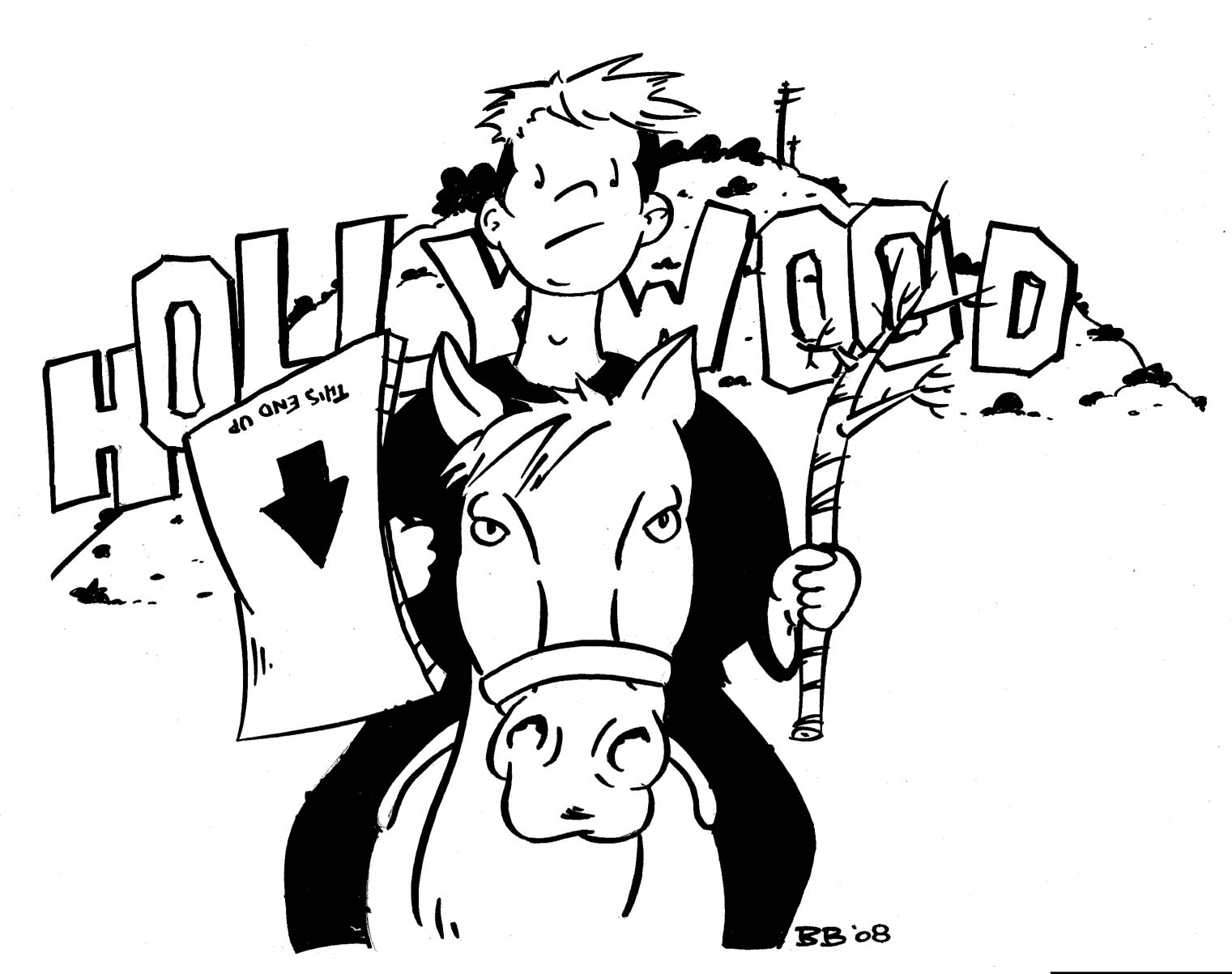
Sancho Panza in Santa Monica

Illustration from Razorcake #46 by Brad Beshaw

Illustration from Razorcake #46 by Brad Beshaw

I read Don Quixote as I gear up for my Hollywood moment: a lunch meeting with an actor and a director to discuss a screenplay that I have written. Since this is a Hollywood moment, I guess I’m not meeting for lunch or getting ready to eat lunch, I’m “doing” lunch. And what had brings me to this parking lot outside of a French deli (really? A French deli?); what has led me to write, of all quixotic things, a screenplay? All of that will have to wait for a while. In the meantime, Don Quixote has to charge into the Spanish plains to defeat the notorious Polish-Turkish-Egyptian army, who have cleverly disguised themselves as sheep.

Don Quixote is a misunderstood figure. He’s been simplified and mythologized in our cultural representations of him. We’ve come to forget the actual character that Cervantes wrote about. He’s kind of a Rip Van Winkle in the sense that, if you read Washington Irving’s story about Rip, you recognize that Rip was a drunk, a deadbeat dad, and a draft dodger who went on a twenty-year bender and made up a crazy story about sleeping for twenty years to cover his ass. But now Rip has turned into a Disney cartoon and a kid’s story and everyone wants to believe his silly alibi about sleeping in the woods for two decades. I like him better as a drunk. Don Quixote is the same way. We all know the story about him seeing windmills on the plain, mistaking them for giants, and charging them atop his swayback nag. The windmills, of course, win. We interpret this act as the all-too-human chase after crazy dreams. We anoint Don Quixote as the patron saint of lost causes and futile endeavors. Look at him: he thinks he’s a knight and there haven’t been knights for centuries; he made his face shield out of cardboard and his lance is just a crooked tree branch. He must be mad. What we forget, though, is that Miguel de Cervantes wrote about a different Don Quixote. In Cervantes’s novel, Don Quixote is not crazy. Not really.

This is as far as I get in the novel when the actor, Stu Smith, comes up beside my truck. I’ve known Stu since we were kids, since he moved into my neighborhood and instantly became the butt of two jokes. The first joke was about his dad, an aspiring stock broker who rode a moped. Sometimes we’d see him in the morning, us riding our bicycles to school, Stu’s dad, decked out in a suit and tie, riding his moped to the brokerage. Even the briefcase bungeed to the back of his moped was funny. The second joke was about Stu being Jewish. He was known around the neighborhood as Stu the Bufu Jew. I called him that, too, even though I was only ten and had no idea what a bufu was. To be honest, I didn’t even know what a Jew was.

Now when I see Stu, decades of memories float to the surface. Little moments long stored in the recesses of long term memory emerge. Like that time Stu and I were hanging out at a dull high school party and Stu formed a plan to make things better. I followed. We wandered a block away from the party and Stu uprooted a mailbox. I uprooted another. We switched the two out, then sallied on, pulling out mailboxes, swapping them with others, making sure that no house had the right mailbox in front of it for two blocks down Catalina Isles.

Of course it was ridiculous, but it was something to do.

And now Stu is an actor. You don’t know this, but you’ve seen him on TV. He’s one of the tens of thousands of faces you pass as you flip the channels. Sometimes, he’s painting his face and chanting, “Roughing the palate!” in a beer commercial, sometimes he’s flirting with Wanda Sykes in a sitcom, sometimes he’s in a robot costume on the Jimmy Kimmel Show or a banker on a drama destined for cancellation after four episodes or a burn victim or an angel or a golfer. Most of his roles are credited as either an occupation or a number: Heart and Lung Technician, Customer #2. I once rented the movie Rat Race, fast-forwarded until Stu popped onto the screen as a co-pilot, rewinded and watched Stu and the pilot bang heads about fifteen times, laughed like hell each time, then turned off the movie. That was two dollars well spent.

Stu is a big part of why I wrote the screenplay. In the screenplay, the main character is named Stu, nicknamed Stu the Bufu Jew, and he sometimes dresses in a suit and rides a moped.

In real life, Stu stands in front of me as I still have half of my head in Don Quixote and I can’t help wondering about Stu as an actor and me as a screenwriter, and thinking, which one of us is Don Quixote in this scenario? I’m the one living in my head when I write the screenplay. Stu is the one who’s hoping to act it all out, though in a socially acceptable way. Can we both be Don Quixotes? And, if there’s two people living out the delusion, doesn’t that go against the very notion of Quixote’s insanity? After all, the only difference between delusion and reality is corroboration. If Don Quixote’s squire, Sancho Panza, had seen giants on the Spanish plain instead of windmills, then Don Quixote wouldn’t have been delusional at all. He would have been a fallen hero.

And what about Sancho Panza, the squire? If he really believes that Quixote is mad, why does Sancho go along with him? Why does he leave his wife and child and ride out onto the Spanish plains with a man who believes himself to be knight, especially when you consider that Sancho knows he’s not going to get paid for all of his efforts? Is Sancho really as stupid as generations of readers have accused him of being?

Stu sees what I’ve been reading. He tells me that, after he acted in his first play, his parents gave him a gift. It was a matching set of Spanish statues, one of Don Quixote, the other of Sancho Panza. This information freaks me out a bit. I don’t say anything. We head to the deli.

The restaurant is perfect for people in the movie business in the sense that it focuses more on image than substance. A ham sandwich is called “jambon de Paris,” a salami sandwich is a “saucisson.” We meet up with the director and he’s a Hollywood insider in the sense that he makes a living off of movies. He’s written several screenplays that have turned into movies starring, well, big stars. He’s also a Hollywood outsider in the sense that he’s recently written and directed an independent film that features no stars, that he funded himself, and that he’s been showing at film festivals all around the country. He’s got a few suggestions for revisions on the screenplay, little things that he knows from making movies and I don’t know because I’ve only written novels, short stories, Razorcake columns, and that type of thing. Overall, though, he likes the screenplay. He likes it enough to offers to direct the movie, even though he knows there’s no money in it and he’s just turned down an offer to direct a movie for the Lifetime network. When the director makes this offer, I look at Stu. It suddenly becomes clear to me which one of us is which.

Maybe I imagine it, but I think I see the flashes of thoughts in Stu’s eyes. Maybe he can actually make this movie. Maybe he knows people who can fund it. Maybe he can actually be the star and not the guy laying on a stretcher, covered in burn-victim makeup. Maybe those aren’t really sheep on the Spanish plain. Maybe he really is taking on the Polish-Turkish-Egyptian army. Maybe he could be a knight.


Before Don Quixote set out on his adventures, he was a hidalgo. Hidalgos were landed gentlemen who, in the early seventeenth century, had no real means of supporting themselves, but social conventions dictated that they could not work or earn money. So Don Quixote was both a member of the nobility and a victim of abject poverty. He was literally starving went he set forth on his first sally. Sancho Panza was socially and economically below Don Quixote. After they set out on their adventures, though, they managed to find big, free meals most nights. They flirted with attractive (and sometimes horribly unattractive) women and fought with rogues; they met interesting people and heard great stories. Insane, stupid, or not, they had a lot of fun. Even if most of their adventures left them battered and bruised, they still ended up leagues above the slow starvation that ate away at them when they stayed home.

When Stu started his acting career, he was coming off of a ten-year stint as a stock broker—a job that ate away at his stomach lining, that pushed him into middle age before he had time to reach his thirtieth birthday. When my first novel came out, I worked as a construction superintendent—a job that made me feel like I was starving even as my weight ballooned.

Now I watch the flickers of maybes in Stu’s eyes. I feel a little like Sancho, sitting on my mule, drinking my wine, not sure yet whether or not I’ll jump in and help out if Don Quixote starts to get his ass kicked again. I reminisce about writing the screenplay and about all the childhood memories it triggered and about how time has let me and Stu take some of the pain of adolescence and turn it into a comedy. I listen to the director tell these dazzling stories about the Hollywood only insiders see. I eat my glorified salami sandwich, and even that tastes pretty fucking good. And, at this point, it doesn’t matter to me whether the movie gets made or not. Insane, stupid, or not, it’s all been pretty fun, leagues above the slow starvation of doing nothing.


Author’s note: This is the fourteenth chapter to a collection of Razorcake columns I wrote.  It originally ran in Razorcake #46.  For more information about the collection, read this post.

The Mexican Break-Up

Illustration from Razorcake #44 by Brad Beshaw

Illustration from Razorcake #44 by Brad Beshaw

Mexico is nothing like I expected it to be. I had a collage in my head of Mexico, pasted together with images of Zapatistas in Chiapas; Jack Kerouac sweating out dysentery in a Mexico City hospital; Jessica Abel trying to fuse back her identity in La Perdida; various PBS documentaries about U.S. corporations blazing a trail of toxic waste and labor outrages across the Mexican desert; and soap operas on Univision that I can only understand about every third word of. So I guess that’s what I expected to find: revolutionaries, artists, hipsters, corrupt businessmen, desperate poverty, and full-figured women with generous displays of cleavage. And, in a sense, I’m sure all of that is here; it’s just not front and center.

So what is front and center? Wine country.

I didn’t even know Mexico had wine country until Jim and Nuvia decided to get married down here. Now, I’m three days deep into it.

The wedding is over. I remember it. I remember the conversations I had and the last drink I ordered and the ride home and going to bed. Nothing too crazy. If, ten years ago, you told me that Jim Ruland was getting married and having an open whiskey bar, I would’ve counted on drinking way too much, sliding into blackout, waking up the next morning not sure how I got home, and wincing when I heard stories about how I made an ass out of myself and generally ruined the festivities. Now, I make a rule of not drinking whiskey like that and definitely not drinking whiskey when Jim Ruland is around. So here it is, the morning after his wedding, and I’m feeling fine. Healthy. I woke up early. I had a glass of Mexican tap water already and even that isn’t bringing me down. It’s time to get to the matter at hand.

I grab my book and a chair and head out to the balcony. It’s a little chilly out here. I’m a couple thousand feet above sea level. The mist from the Pacific Ocean forms into a cloud, drifts east for several miles, and settles in this valley. The mountains are completely engulfed in fog. The grapevines below drip with dew. It’s May in Mexico, I’m wearing jeans and a hoodie, and I’m still a little cold. I don’t pay much attention to this, though, because I’m at the end of a long journey here.

My book is in my lap. Really, at this point, it’s a manuscript. It’s called Train Wreck Girl. I printed it out a few days ago. I punched three holes in each sheet of paper and stuck them in a three-ring binder. On the drive down and during lulls between wedding parties, I’ve been reading back through it. I’ve made little notes, added small paragraphs here and there, and addressed issues that my editor asked me to address. I’m down to the last few pages and it occurs to me that this is it. When I type these changes into my computer, the novel is done. Done done. The changes I make this time are the last changes I’ll make to this book. After this, it goes to the publisher, to the printer, and to bookstores. After this, it’s fixed, set in type. It no longer belongs to me. It belongs to the reader. Is this a scary feeling? Yes. Is it a great feeling nonetheless?

Fucking-A.

Patricia Geary once told me that writing a novel is like getting involved in a long-term relationship with someone. Writing a short story is like having a one-night stand: it’s fun and wild and you are emotionally invested, just not that much. Writing a novel, though, is agreeing to get serious with that person. You’re going to start dating regularly. It’ll be fun and exciting. Pretty soon, it’ll start absorbing all your time and thoughts. It’ll get intense. You’ll wonder what it is, exactly, that you’re doing. You’ll wonder if it’s worth it. You’ll go through rough patches that you need to work on. You might even break up for a while. But there’ll be something there that you just can’t walk away from. You’ll go back to it, again and again, it doesn’t matter how many times and how much it consumes you. You’ll make it work.

The difference is, when you get involved with a person long-term, there’s a chance that you can make it last for the rest of your life. With a novel, sooner or later, you have to break up with it. So that’s why I brought this novel down to Mexico with me: to tell her, “I think I gave you all I could, but we’ve gone as far as we can together. It’s time for you start spending time in other people’s imaginations.”

More images flash through my mind. I first started flirting with her back in 1999. I was working as a construction superintendent, spending huge chunks of my day driving from job site to job site, dealing with the stress of work by losing myself in daydreams about barely-formed characters. As those daydreams increased, I realized that things were getting serious. Something needed to be done.

In February of 2000, I quit my job, started teaching part-time at the local community college, did some freelance tractor work when it was looking like I wouldn’t make rent, and spent five or six hours a day for about six months typing away. I wasn’t sure where the novel would go, but I let it do its thing.

I was surfing a lot in those days, so the ocean seeped its way into the novel. I rode my bike most places around town, so the main character got a bicycle and started riding. I read a lot of crime novels—Raymond Chandler, Jim Thompson, Dashiell Hammett, Chester Himes—so a novel about sunny Cocoa Beach adopted some noir elements.

One night, I’d been writing until about two in the morning when I reached a point where I couldn’t go on and I couldn’t sleep. I decided to hop on my skateboard and ride around the neighborhood until I was tired enough to go to bed. I kicked around the vacant streets for a while, full moon shining down on the warm summer night. A rental sedan pulled up next to me. A middle-aged businessman rolled down his window. He was drunk. Clearly. He asked me if there were any hot spots to check out in Cocoa Beach.

“It’s two-thirty in the morning,” I told him. “Everything’s closed.”

“What about women?” he asked.

“What about them?”

“Do you know where I could find any?”

I realized that, in his booze-addled mind, he thought perhaps he’d run into a skateboarding pimp. I told him, “Yeah. What you want to do is go home, sober up, go to work tomorrow, and ask out the woman in the office who you’ve had a crush on for the last six months.”

The guy told me to fuck off and drove away. I went back to riding around the vacant streets, wondering if a skateboarding pimp would make a cameo in the novel.

He didn’t.


In late 2000, I finished writing the novel. I titled it Crazy Broads and Dead People. I proudly printed up all 350 pages of it, put it in a three ring binder, and read the complete draft for the first time. When I was finished, I was struck with the realization that this novel—for which I’d quit my job, on which I’d spent several months working like mad—completely sucked. I mean, it sucked bad. I almost deleted it. That might not have been a bad thing.

I spent the next few years trying to fix it. During that time, I did other things. I had a bunch of one-night stands with short stories. I wrote enough of those to put out two short story collections. I also helped found this here magazine. And in the midst of it all, somewhere in late 2003, I made the executive decision that Crazy Broads and Dead People was bullshit and we were broken up for good.


During the summer of 2005, I went on two tours to support my short story collection Barney’s Crew. A brutal heat wave hit the northeastern U.S. Joe Meno, Mickey Hess, and I did a reading in the loft of a Pittsburgh bookstore. It was about a 105 degrees. No one bought a book from any of us. The next night, we read in New York City. It was so hot inside the art gallery that we decided to take the reading outside. I went first. It was New York City: loud, hot, smelly. An ambulance raced down the street, only to be blocked by a double-parked car. I stood on the sidewalk for three minutes, mid-story, waiting for the parking violator to move his car so that I could be heard over the blaring horn and sirens of the ambulance. In Boston, two people showed up to our reading. That’s it. Just two. In Montreal, after another hot night of readings, the drunken owner of gallery where we did the reading told me that I needed a shtick. He told Mickey to try to incorporate more props into his reading. Mickey and I went across the street and got drunk.

The next morning, I lay in the back seat of a rented Toyota Echo, wallowing in the hangover brought on by those four readings and a tour that was turning into a bummer. I felt bad for bringing Mickey and Joe into this mess. I felt bad for the tens of thousands of miles I’d traveled and the hundreds of readings in dozens of cities. I felt bad about the wall of apathy and silence that greeted my new book. I felt bad for everything.

But self-pity is the lazy indulgence of emo kids. I needed to snap out of it. I listened to Mickey and Joe, who seemed undaunted. They talked about writing, their new projects, and what their favorite writers did that worked. As I eavesdropped, it occurred to me that the one person who could pull me out of this malaise was Danny McGregor, the hero (or anti-hero) of Crazy Broads. I went searching through the alleyways of my brain, hoping to find him.

He was there.


When I got home from that tour, I started working with Danny again. I wrote every morning for five or six hours, using the same basic plot and characters from Crazy Broads, but writing a whole new novel. I didn’t even dig out my old copy of Crazy Broads. Why should I? It sucked.

Within a couple of months, I had the rough draft of a whole new novel. And this one, I liked.

Within a couple of years, I’d gone through a dozen revisions, sold the novel to Manic D Press, worked with the editor there to clean things up even more, scrapped chapters and added chapters, and read through everything one last time down here in Mexico.

And now, here I am. It’s late May, 2007. I’m ready to say goodbye to the writing of Train Wreck Girl, ready to hand her over to my publisher, to printers, and to you. It’s an Annie Hall kind of break up. I wish her the best. I’m better for the time we spent together. But, as the sun burns away the fog and the panorama of Mexican wine country opens into another day, I’m ready to move on.


Author’s note: This is the thirteenth chapter to a collection of Razorcake columns I wrote.  It originally ran in Razorcake #44.  For more information about the collection, read this post.
Hoodlebugging

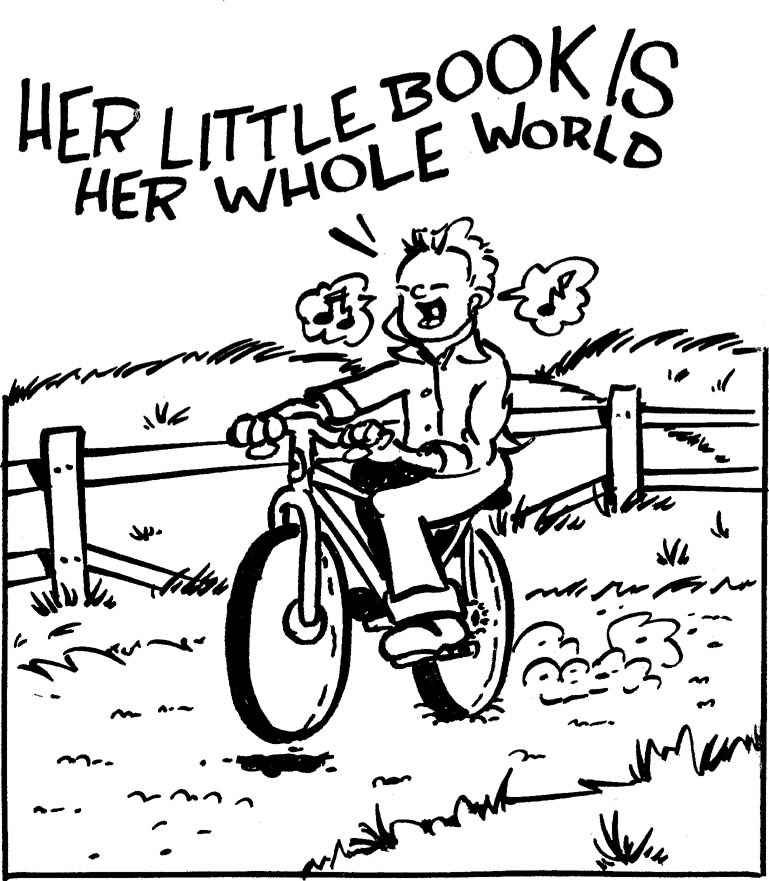
Illustration from Razorcake #41 by Brad Beshaw

Illustration from Razorcake #41 by Brad Beshaw

I rode my bike down the Hoodlebug Trail in western Pennsylvania feeling like I was stuck on both sides of a time machine. The trail itself was paved over an old commuter railroad line that started in the Pennsylvania town called Indiana and ended in Blairsville. Little reminders of the old days still ran along the buried tracks. Groundhogs stood to peer across a fallow field, chipmunks scattered away from my shadow, a buck paused on the trail before racing down to a creek to drink. The ghosts of nineteenth century industry—coal mines and iron furnaces and the young growth of a clear-cut forest—floated around me. The trail also intersected little reminders that I was very much in twenty-first-century America: the wastewater treatment plant; the baseball field with a painting of the nuclear power plant below the scoreboard; the actual nuclear power plant behind the baseball field; the freeway that ran sometimes dangerously close to the trail; the iPod I had plugged into my ears, blasting the Descendents. As I crossed over Two Lick Creek, I caught a glimpse of a billboard through the trees. It showed a picture of a freeway and said, “DNT TXT N DRV.”

It took me a few minutes to figure out what the hell it meant. I kept trying to figure out what DNT stood for. Descendents Nuts Transfer? Donuts Next Town?

You, on the other hand, if you have a cell phone, if you’ve sent a text message before, if you don’t have the Descendents and donuts on the brain, probably knew right away what the sign said. You are one up on me. I was a mile down the Hoodlebug, thinking about something entirely different when suddenly Don’t Text and Drive popped into my head. Perhaps because this revelation hit me right in the middle of the song “Hateful Notebook” in the middle of the Trail That Is Twenty-First-Century America, my brain started reeling.

Earlier this past summer, I read a book called Orality and Literacy by Walter Ong. It’s the kind of book that you only read if you’re a geek or an English professor. Since I’m both, I loved the book. I won’t bore you with all the details, but what you need to know about it is that Ong discusses the ability to write and read as a technology—which it is, though we’re so accustomed to it that we don’t see it that way—and it’s the technology that made Western Civilization what it is. Ong says that in cultures that have never been exposed to reading or writing, thought patterns are completely different. Cultural mores, laws, traditions, etc., are all memorized in the form of an epic poem. Because there’s no dictionary, people’s vocabularies are only a few thousand words. People living in oral culture are no less intelligent than people living in a literate one, but they do think differently. Writing and reading changed the way people think. For one thing, when we are able to write, we can literally take thoughts out of our heads and store them somewhere else. In other words, I don’t have to allocate any mental space to, say, avocados when I’m hungry for guacamole. Instead, I can just write a shopping list and put avocados, jalapeno peppers, garlic salt, tomatoes, tortilla chips, and beer on it. That way, I can forget about those items until I get to the store and read my list. In the meantime, my mind will be free to wonder about things like the Descendents song “Hateful Notebook.”

It’s on perhaps the most underrated Descendents album, Everything Sucks. In short, it’s a song about a girl who writes all of secrets into her notebook and the narrator of the song wants to know what’s in it. More than that, though, the narrator wants to read what’s in it. Because there’s a difference between knowing what’s in a notebook and reading what’s in a notebook. When you know what’s in a notebook, your mind assimilates the information into your thought processes, changing exactly what is written into your vague conception of what is written. When you read it, though, you know exactly what is written, exactly the thoughts that she had in the way that she wanted to express them with all the complexity, innuendo, and nuance she used. He can go back and read and read that notebook and what he knows will grow. More meaning will come out of those words. He’ll think about it as “reading between the lines,” but he’s not reading between them at all. He’s just gradually coming to a better understanding of what they say. And that’s one of the really amazing things about reading and writing: meaning grows as you continue to reread. Even the simplest diary will become more complex, more elucidating the more you read it. Words and sentences carry a lot more information than we usually give them credit for.

In a way, that works in oral cultures, too. I’m sure when those poor Athenian bastards had to memorize The Iliad, the meaning grew with every recitation. In their minds, it probably started out as a war story, morphed into a gay love story, and eventually became the law of the land. It’s not all that different from me listening to that Descendents album a hundred times and singing along to all the words until the meanings grew and grew and eventually led me to thinking way to hard about it while I rode the Hoodlebug and creating a whole scenario about this sad little goth girl and her black and white composition notebook, using a nubby pencil to write all about how 45 Grave really gets her, and the too-skinny dude with his horn-rimmed glasses and DIY buzz cut and huge internal desert of insatiable longing.

But I have time to think about these all of these ridiculous things. Why? Because I come from a literate culture that allows me to take most of my thoughts and store them on paper somewhere, or allows me to borrow or access thoughts that other people put on paper so that I could use them when I want to.

And since I had this time, I used it to wonder what the fuck DNT TXT N DRV really means? I mean beyond “don’t text and drive.” What does it really mean?

One of the things that Ong talks about is the turning point of literacy. Originally, people used writing just as a way of counting money or storing stuff. Want to know what’s in that basket over there, look at the picture of the olive on the side of it. Want to know how much money you got for those olives, count the number of vertical lines you drew on that piece of bark. From there, the circles and lines got more advanced. They started to mean more. But what really changed everything was the vowel. Before the vowel, the circles and lines couldn’t be read the same way by everyone. Where one person sees an olive, another sees and orange. Where one person sees DNT and reads it as don’t, another person reads it as donut. What separates the don’ts from the donuts? The vowel. Put a vowel in a word and anyone can learn to read fairly accurately. And once anyone can read, everyone is able to take thoughts out of their heads and store those thoughts in a way that’s accessible to a broader population. Laws, mores, and traditions don’t have to be memorized. Just write them down and look them up if you need to. Free up your mind to invent new stuff to maybe make life easier.

When you consider this, you realize that everything we have in this culture of ours—from bicycles to baseball games to train tracks to blacktop paved over train tracks to nuclear power plants to iPods to aging punk rock bands—can be traced back to one single technology: the vowel. And now we send text messages that treat the vowel like it doesn’t even matter.

But that’s not my point. This isn’t just a long rant to say that text messaging sucks. I have no idea whether or not it sucks. I don’t have a cell phone. I’ve never sent a text message. Hell, it usually takes me anywhere between a week and forever just to answer an email. There’s no way I’m going to walk around with some little machine that lets people send little vowelless messages about the minutia of their day. I’d rather ride my bike and listen to the Descendents.

At least that’s where I am right now. I’m very happy that I don’t have a cell phone, just like there was a time when I was very happy that I didn’t have an email account. And it’s not because I’m a Luddite. I love a lot of new technology. I was listening to an iPod while I Hoodlebugged. Sure, the music doesn’t sound as good as it does when I play it on vinyl, but it’s a hell of a lot more convenient than riding a bike with a record player on the handlebars. The bike I was riding was pretty state-of-the-art, too. I don’t know what kind of metal it was made of, but it’s a lot stronger and lighter than the steel that they used to smelt in those huge old furnaces that still dot the western Pennsylvania landscape. Even when I type this, I’m using a laptop and Microsoft Word. I may not be a fan of Microsoft and Word may have its own problems, (what with all the changes it makes to words while you’re typing them; you can hardly even type “teh” anymore without the program changing it to “the.” You can hardly type Hoodlebug without a red squiggly line underneath, even though I know it’s a real word and I’m spelling it correctly). Word freaks me out sometimes, but it’s still a hell of a lot better than the old Smith Corona word processor that I wrote my first novel on. It definitely beats the shit out of the electronic typewriter I used to write essays in high school.

But because I’m of that generation that grew up from typewriter to word processor to Word, I’m even more aware of how this technology changes our way of thinking. When I used to write on a typewriter or use a pencil (like my imaginary Hateful Notebook girl), I really thought about what I wanted to say before writing it down. I mean, I really thought about it. I didn’t want to have to type out a whole new page just to fix a sentence. I didn’t want a page full of crossed out or erased words. The word processor changed that a bit, but it wasn’t until computers got cheap enough for me to be able to afford one and I started to use Word that my method of writing really changed. Now, I write as a think. I type sixty words a minute. I keep about forty of them. I use the backspace key more than I use the letter “e.” And there’s a fuckload of “e’s” in this column.

Getting back to the Hoodlebug and the DNT TXT N DRV billboard (a phrase which, not so incidentally, does not get a squiggly line under it when you type it in Word), it was at that moment that I realized just how significant all these little insignificant things like cell phones and iPods and laptops are. When the railroad tracks are paved over to make a bike path or when the clear-cut forests grow back everywhere but where the nuclear power plant is, those are just changes to the way we get around or the way we get energy. When groundhogs gaze across fallow fields, it’s just a different thing for me, a guy who lives in California, to look at. Their part of the change that is all around us and perpetual and part of the normal human experience. The actual things, like my bike and the power plant, may be unique to our time period, but they’re just part of the chain of creation and destruction that have surrounded western civilization for a few thousand years. But that little computer chip that was sitting on my hip, mainlining punk rock tunes into my ears, or the computer chip that connects careless drivers passing out essentially meaningless and vowelless messages to one another, and that chip in the laptop that helps me to write this all represent something much larger than a change in our environment. They represent a change in the way our minds are working. It’s a change in the way that we think, a change bigger than anything humans have undergone since they first came up with the vowel. And, goddamn, none of us knows where this is going to take us.


Author’s note: This is the twelfth chapter to a collection of Razorcake columns I wrote.  It originally ran in Razorcake #41.  For more information about the collection, read this post.

Another Anthem for the Disenfranchised

sean_toysthatkill_todd_good_2_FINAL

Todd Congelliere and some dancers in a makeshift venue in San Pedro

San Pedro is a good place to go when you’re looking for answers. It’s at the end of LA’s craziest freeway, south and central of South Central. It’s a tangled mess of dirty water and industry, glowing even at night in the toxic orange lights of the Port of Los Angeles. In a way, Pedro is America. It’s where the dock workers went on strike a few years ago and the president forced them back to work, arguing that America doesn’t run without the Port of Los Angeles. Of course, no one asked the question: if America really depends so much on these guys, why don’t we give them a raise? America doesn’t really depend on the president. Positions of power here are like the mythical hydra. Cut off Bush’s head and another corporate shill will sprout in his place. Cut off the salary of the Pedro dock worker, and we’re all fucked.

But these weren’t the answers I was looking for when I headed down to Pedro last week.

I went down there for two reasons. First, because Toys That Kill were playing with The Marked Men. A few weeks earlier, Toys That Kill played their record release show. I missed that one. The next day, though, I was hanging out with Razorcake columnist Jim Ruland and writer Roy Kesey. They’d both been to the show. It was the first ever punk show for Roy. He kept talking about it. He told me, “It wasn’t what I expected punk rock to be. No mohawks. No leather.” And: “It was the friendliest mosh pit. Kids would knock the shit out of each other, but stop and help up anyone who fell down.” I knew this about the show. I didn’t have to drive down to see it. Still, to hear Roy talk about it, to hear the amazement in his voice, felt like a clue of some sort. Another clue came from Ruland, when he talked about Toys That Kill playing the anthems of the gutted San Pedro kids. I listened to Roy and Ruland and kicked myself for missing that Toys That Kill show.

I didn’t miss the one with The Marked Men, though. Like I said, I was down there searching for answers. Or at least for a little insight. Because I’m worried about kids today. I’ll explain.

In typical Pedro fashion, venues changed on the day of the show. There was no listing for the show in any of the weeklies or online. The venue switch was publicized strictly by word of mouth. Still, word of mouth spread. Thirty or forty kids were milling around the venue before the first band had even played.

I forgot the first band’s name. They were from Boston. They weren’t bad, but they weren’t that good, either. Halfway through their set, the singer said, “I’m freaking out to be playing in the home of the Minutemen.” I was thinking, no shit; you’re copping more riffs off of Mike Watt than Mike Watt cops. I headed across the street to get a tall boy and brown paper bag to hold it in.

It was about ten o’clock on a Friday night. The local drug store was packed. It was obviously the spot where the locals got their booze. Different groups of kids milled around. I didn’t recognize faces, but I recognized the scenes: the goth girl with her pasty white skin and black eyeliner; the chicano metalhead who looked straight out of 1986; the mohawked punk with his pegged black jeans (who wasn’t headed over to the TTK show, by the way); the sad indie rockers with their Morrissey shirts; the hip hop kids; the dirty hippies; and of course me and the TTK refugees in our black t-shirts and jeans. Nothing new there. Nothing too strange except that I realized that every group of kids I saw was in their early twenties and ever scene they represented—goth, metal, punk, hip hop, indie rock, hippie—was in its twenties or older, too. These kids were dressed in the uniforms that their rebellious parents could’ve worn. And there’s something fundamentally off about that. It made me wonder where the next great youth movement was going to come from or if it would come at all.

Now, I know I’m basing my judgments on these kids solely on their clothes. I know that there’s more to a subculture than their clothes. I also know it seems like I’m looking down on these kids like the grumpy old man saying, “Goddamn it, get your own scene.” That’s not my intention. Because I don’t care. Dress however you want. Rebel however you want.

What concerns me about all these kids, though, is the time period when the fashions of scenes seemed to freeze. The mid-to-late eighties. It was exactly when corporations started to realize how to capitalize on youth movements, how to figure out exactly what the hot new trends were and how to repackage these trends so that it could be the corporations selling these trends back to the kids who started them. Over the past ten years, with the help cool hunting and data mining, this repackaging and co-opting of youth has only gotten quicker and more effective. Even the latest trend to promote independent music, Myspace, was purchase by Newscorp earlier this year. Newscorp (the media giant that owns Twentieth Century Fox and Fox News) paid $580 million for Myspace. They hope to recoup a lot of that money by selling demographic information from Myspace pages to advertisers. Take a second to think about that. Remember that old Jawbreaker line? “Selling kids to other kids.”

This repackaging of trends, this drive to sell our own culture to us, is having exactly the effect that you’d expect. Our music, our scenes, our lives become stagnant and superficial. It can get depressing. So I bought my tall boy and headed back to the show.

The Marked Men were setting up when I got back there. There was no sound man or sound board. Just a P.A. and a guy standing at the front of the stage, fiddling knobs. The venue was less of a venue and more of an abandoned space at the end of a rundown commercial building. Plaster flaked off the walls. The ceiling had holes in it. The floor was bare concrete. No advertisements hung on the wall. There was no doorman, no security. I don’t think anyone was actually working there. The only people dealing with money in the joint were the bands selling merch and the guy passing the hat for the bands. Nothing but the music and the people who came to hear it.

Enter The Marked Men. They’re definitely one of my favorites. When their album On the Outside came out a couple of years ago, it got stuck in my truck’s CD player. No malfunction on the part of the stereo; I just couldn’t bring myself to take the CD out. And since I pretty much only drove that summer when I was driving to the beach to go surfing, that album is etched in my mind as a sign of good things to come. They were touring this time to promote their new album, Fix My Brain. I hadn’t heard the new one yet. From the opening chords of their set, from the pure energy and excitement, from the kids swirling around me, going nuts, I knew The Marked Men were on to more good things to come.

There’s more to The Marked Men, though. They come out of a scene in Denton, Texas, that’s given birth to a few bands whose albums get stuck in my stereo: the Chop Sakis, The Riverboat Gamblers, High Tension Wires, The Reds. Now, granted, a lot of those bands have overlapping members, so the music scene in Denton may be smaller than I imagine. And, granted, The Riverboat Gamblers are on the Warped Tour this summer and, considering their amazing new album and live show, they are poised to be the next big thing, the next trend to be co-opted and sold back to us. That hasn’t happened yet, though. We’re still in that pure time when the Denton bands and their music have developed organically. It’s still a music scene that exists because we love the music, not because someone is trying to sell it to us. In a lot of ways, this was the perfect place to see The Marked Men—a word-of-mouth show in an abandoned commercial space. Nothing for sale but the stuff the bands sell to keep themselves on the road.

Up next was Toys That Kill. TTK is the band I’ve seen play the most in the past five years. Part of this has to do with the bands that TTK bring to town and play with. I guess I have pretty similar tastes in music with these guys. I have to thank them for bringing me shows with Dick Army, The Knockout Pills, Shark Pants, The Fleshies, The Arrivals, Tiltwheel, The Thumbs. The list goes on. Recess Records, the label that TTK singer/guitarist Todd runs, has put out albums by bands that have graced four Razorcake covers.

Most of the reason I’ve seen TTK so much has to do with how much fun it is to be at their shows. They have a following, a core audience that’s always there. I don’t know what to call this group. They’re loyal as deadheads and drunk as dock workers on their days off. I don’t know any of them personally, though I’ve seen them at dozens of shows. It’s enough just to watch them, to feel their energy, to see them singing along to every word of songs that are on an album that was released two weeks earlier.

And again, down here in Pedro we have something that mirrors Denton. We have a living, breathing scene that exists for the music and for the people who love it. It’s not flashy. It’s not what Roy Kesey expected to see at a punk rock show. And it’s not really punk rock in the original sense. It’s grown and evolved miles away from the original movement. The bands aping the old heroes draw yawns. The bands finding new ways to make high energy rock’n’roll etch the signs of good things to come.

So, yes, it’s a little bit of optimism. A show untouched by corporate culture. Anthems for the young and disenfranchised played in a way that they can’t be repackaged and sold back to us. It’s a beautiful thing.

But it’s not that simple.

On the long drive home, across the concrete expanse of LA, I kept thinking about it. Shows like The Marked Men/Toys That Kill one are a beautiful things. They’re connected to larger things, other scenes in other towns that are doing the same type of things. They’re signs of a living, breathing culture that exists because we want it, because we love it, not because someone wants to sell it to us. But when the sweat dries and the excitement wears off and it’s just me in my truck, rolling down another freeway, immersed in the cloned towns that engulf America like the repeating backdrop in a cartoon, I have to wonder if these little oases of culture can ever irrigate this dry society we live in, or is it just a matter of time until someone buys the oasis and sells us the water?


Author’s note: This is the eleventh chapter to a collection of Razorcake columns I wrote.  It originally ran in Razorcake #33.  For more information about the collection, read this post.

Portable Doom

Illustration from Razorcake #54 by Brad Beshaw

Illustration from Razorcake #54 by Brad Beshaw

Rain poured down, filling ditches and flooding the concrete quad with about an inch of water. I sat in the portable that was designated as faculty offices. It was Friday morning, one of my favorite times to teach a college class. Colleges and universities are about half empty on Friday mornings. It feels like the edge of Spring Break every week. I half-listened to the rain and half-read through my class notes and tried to remind myself that I would be a college professor for the next three hours and I should act like one. That’s when I heard the crash.

I couldn’t place it. It sounded like a wrecking ball smacking into the side of a building, but where would a wrecking ball come from on this rainy Friday morning? I raced outside the faculty offices and had a look around. My portable was one of eight that surrounded this flooded concrete quad. The rain padded against the inch-deep pond, jetted out of rain gutters, formed little streams in the ditches. No one was around to race out of any of the other portables and look at me so I could look back at them and shrug my shoulders and at least acknowledge that I too had heard a crash and we hadn’t been imagining things. Alone there on the west end of campus, I did what I could. I grabbed my umbrella, walked over to the portable where I’d be teaching, unlocked it, and had a look around. Everything seemed in order. I left, leaving the door unlocked so that my students wouldn’t have to wait out in the rain.

I went back to sitting on my broken office chair, half-listening to the rain, half-reading my class notes.


At break time, I went back to my desk in the faculty portable and ate an orange. Another professor was there by this time. He said, “Did you hear about the air conditioner?”

I couldn’t make sense of this. Air conditioner? It was February in Los Angeles. Who talked about air conditioners? I shook my head.

He said, “An air conditioner fell through the roof of #6 this morning.”

“What?”

“Yeah,” he said. “I guess the gutter got clogged, the roof filled up with rain, and everything came crashing down. Crazy, huh?”

“Crazy,” I said, knowing that I’d have to spend the next hour and a half in portable #5, right next door. I left the faculty offices and stood in the quad in front of #5, trying to see where the rain gutters were and if they were clogged, trying to find the air conditioner on the flat roof, seeing nothing but the rain and the same dusky brown portable I’d been teaching in for a semester and a half. The umbrella kept my head dry. My Doc Martens kept my feet more or less dry. The rain smacked the back of my legs, though, sticking my jeans to the skin on my calves.

For about a minute, I thought about canceling the second half of class and waiting until the next Friday to see if the roof would hold on this forty-year-old portable. But I didn’t. I decided, all of this may come crashing down someday, and I’ll be under it or I won’t. In the meantime, all I could do was all I could do, which, on this morning, was teach composition to the youth of East L.A. who were trying to claw their way into the middle class.

I taught the second half of the class on the move, walking back and forth in front of the classroom, breaking the students off into small groups and wandering around them, trying to make myself a moving target for the air conditioner and the flooded roof. Since I didn’t know where on the roof the air conditioner was, any spot in the room could’ve been as safe or dangerous as any other. I knew this. Still, I kept moving.

The roof in #5 held for the rest of class and the rest of the semester. At the beginning of that summer, the roof repairs and my job were added to the long list of things that the college didn’t have the money to pay for. I found another job.

Seven years have passed since I’ve been to that campus. For all I know, #5 is still there, still defying gravity through another February’s rains.


I don’t talk about teaching much here in the pages of Razorcake, but I’ve been teaching since the first days. When I decided to move from Florida to California to help found this magazine, I quit my job teaching at a community college there. Quitting to start a punk rock magazine wasn’t as big of a deal as it may sound like. Teaching in Florida pays so poorly, it can hardly be classified as a job. It’s more like volunteer work with a monthly stipend.

With the exception of 2001, when I lived off of savings and worked full-time on Razorcake, I’ve been teaching from the time when I first started doing Flipside reviews until later today, when I’ll go to campus an hour early so that I can let my mind switch over from punk rock columnist to university professor. And, though I don’t mix the university and punk rock much, I teach there for reasons that are very similar to the ones that keep me tethered to Razorcake. It mostly has to do with my belief in democracy.

I know it sounds like a strange thing to say. But I’ll explain. At the core of this is the belief that most of us, individually, tend to make intelligent decisions most of the time. Of course we slip up now and then and do stupid things. Grown men decide to get naked on an escalator in a crowded Hollywood shopping center when they’re supposed to be headlining a show. Fresh-faced punk rockers read Maximum Rocknroll. None of us are perfect. Regardless, if we examine our lives in the big picture, it’s probably safe to say that, when we were left to our own devices, we did what we needed to do to get by, helping the people around us when we could and avoiding hurting anyone too badly. So, it follows logically that most of us can govern ourselves. And, if we can govern ourselves, we should. This is what I mean by democracy.

So where does Razorcake fit into all of this? Well, democracy is predicated on a free exchange of ideas. In order for individuals to make intelligent decisions, they need to receive and consider a wide variety of information. None of that information has to be objective. It just has to come from a bunch of different perspectives. One of the biggest threats to democracy in America is the narrow perspective of information that we receive. A handful of large corporations control almost all of the media, meaning they control most of our perceptions of the world that exists beyond what we experience firsthand. Fresh perspectives need to come from somewhere. Razorcake provides one of these. The ten thousand or so readers of this magazine are able to experience one of the few subcultures in America that still grows organically. It’s an American culture that exists beyond Wal-Mart and McDonalds, beyond Fox and Disney. It’s a culture that we’ve created rather than one that’s been sold to us. It’s liberating.

Universities work in a similar fashion. They’re the largest and most powerful places in society where a free exchange of ideas still exists. University professors have a tremendous amount of freedom with regards to what they study and what they teach. And, unlike most people who are given a pulpit in our society, professors actually have to research their topics extensively and demonstrate an advanced knowledge in their field before they can express their views. They can’t pretend to be an authority on a different topic every night like Bill O’Reilly and Jon Stewart and most bloggers do. They have to actually know what they’re talking about.

Most discussion about universities these days focuses around money and jobs. I’m not as interested in that, mostly because people ignore the facts in that discussion. The fact is, universities are a good investment. A typical California State University graduate, regardless what his major is, will make about a million dollars more in his lifetime than if he hadn’t gone to college. This means he’ll pay about $300,000 more in state and federal taxes. 90,000 students graduated from the CSU last year. Do the math. The CSU made the federal government and the State of California about $27 billion last year. The state invested about $3 billion. That’s a pretty good profit.

But, again, I’m not as interested in that. I’m more interested in the democracy element of it. Because we all eventually get jobs and make some money. And those are important things. But they’re far from the most important things in our lives. What almost everyone wants are things like autonomy, free time that’s genuinely free of work and stress, deep friendships and loving relationships. Money and jobs don’t go very far in granting us those things. What we need instead is a to find a way to create these meaningful things in our own lives without relying on money or jobs or consumables. We need to think critically and be imaginative. And some of the last places that exist where we have the time and freedom and freshness of perspective to do these things are Razorcake and higher education.

Recently, higher education in California has taken a huge hit. Mostly, that hit has come from a few members of the state legislature and from the action hero we elected governor. The CSU—the university I work for—had a half billion dollars cut from our three billion-dollar budget this year. All the economic forecasts show that, regardless of how bad the economy is, taking money from higher education makes things worse. Taking it from the CSU further ensures that people from poor or working class families get booted from higher education while most rich kids do fine. It also means that, as a society, our freedoms become fewer, our chances for meaningful lives become slimmer, and our democracy suffers.

I’m not sure what to do to change this right now. I’m working on it. I know a Razorcake column isn’t going to solve this problem. It’s not intended to. I’m just bummed out. Lately, every time I go to work, I feel like I’m back in that rain-soaked portable, waiting for the roof to cave in on me and my students.

I hope the crash isn’t inevitable.


Author’s note: This is the tenth chapter to a collection of Razorcake columns I wrote.  It originally ran in Razorcake #54.  For more information about the collection, read this post.

The Road to Rock’n’roll


Illustration from Razorcake #38 by Brad Beshaw

Illustration from Razorcake #38 by Brad Beshaw

I was cooking lunch when Joe Strummer’s publicist called. Todd answered the phone. I kept grating cheese for quesadillas. This was in the early days of Razorcake, when Todd and I each did half of magazine from the apartment we shared, when we were working on our fifth issue and still defining what the magazine would be. I didn’t pay attention to the call. I buttered a couple of tortillas, lay one on a frying pan, sprinkled grated cheese on it, and lay the other tortilla on top of it. This was also the days when any and all money we earned went back into putting out this magazine, back when I still considered Top Ramen food and would actually eat it. Quesadillas were a bit of a luxury.

Todd got off the phone just as I finished cooking. He said, “That was Joe Strummer’s publicist. She said she heard a rumor that we were going to interview him and put him on the cover of the next issue?”

“Was she calling from 1978?” I asked.

We both laughed.

The band on the cover of that issue: Super Chinchilla Rescue Mission.


My joke was had less to do with Joe Strummer and more to do with all the publicists who would call and try to play stupid publicist tricks on us. I was and am a Joe Strummer fan. I thought long and hard about that interview. Part of me wanted to do it. The second Clash album, Give ‘Em Enough Rope, is the perfect punk rock album. It’s high energy, full of catchy melodies, has a nice mix of personal and political lyrics and the political lyrics are complex explorations of enduring issues like cultural imperialism rather than politics that come with an expiration date. The trade off of Joe Strummer and Mick Jones vocals are perfect. And, unlike every other Clash album, every song is great. There’s not one low point between “Safe European Home” and “All the Young Punks.” I got the album when I was still young enough to believe that punk rock could save the world. It still sounds great to my old and jaded ears. I’ve played that record so many times that the vinyl seems somehow thinner, more flimsy, like I can only play it another couple of dozen times before I wear completely through it. Still, it gets a lot of spins even now. I listened to it this morning.

In a sense, every album I buy now is a futile attempt to recapture that feeling I got when I first set the needle down on that record.

So I asked myself again and again, “Do you want to interview the creative force behind the perfect punk rock album?” And I always came up with the same answer.

No.

Did I want to meet him? Absolutely. Was he a hero of mine? Of course. He still is. Did I want to bask in the glow of brilliance? Yes. But did I want to waste his time with a bunch of questions about something he’d done twenty-odd years ago? Questions that have already been asked a million times, that he’s answered and that I read the answers to? No. The truth of the matter was, I had no interest in his new project, Joe Strummer and the Mescaleros. I’d heard it was “world music.” One of the songs on the vinyl version of that album is seventeen minutes long. I wanted nothing to do with that. I didn’t even give the disc a spin when it arrived in the review pile. I had no interest. After some of those horrible songs on the Clash’s Sandinista, after living through a couple of decades of “Should I Stay or Should I Go?” and “Rock the Casbah” on high rotation everywhere, I felt like I was done with Joe Strummer. Sure, he’d written great songs since Give ‘Em Enough Rope. There are even great songs on Sandinista. And I loved him the in the movie Midnight Train. But world music? Come on.


After Joe Strummer died, we did run a feature on him in Razorcake. I didn’t write anything about him then because I felt like Eric Rife—who did write the feature—said everything I wanted to say. He said it beautifully. I did the layout for that article. I sat at the computer in my apartment playing every piece of Clash music I had, right down to a bootleg copy of the Clash at the U.S. festival. I photoshopped pictures of Joe Strummer, I moved layout elements back and forth. I read and reread Eric’s words. I spent more time on that layout than I did on any other layout for Razorcake. I don’t know why.


A few months later, I was in a coffee house in Cincinnati. It was at the end of a short book tour I was doing. There was a record store above the coffee shop. I milled around there for a minute and got to talking to the owner. He knew Razorcake. We chatted about the Joe Strummer feature. He said, “I have the new Mescaleros album. Just came in. Wanna hear it?”

I didn’t, really, but I said, “Sure.” Just to be polite.

He played the first song. “Coma Girl.” I thought, wow! This is a song I’ve been wanting to hear for twenty years. Holy shit. I made a huge mistake.


Shortly before Joe Strummer died, filmmaker Dick Rude went on the Mescaleros’ final tour and made a documentary on it, Let’s Rock Again. The documentary has been out for a couple of years, but I didn’t get around to watching it until recently. There’s one scene in the middle of the movie when Joe Strummer is in Atlantic City. He’s scheduled to do a show that night. He goes to a rock’n’roll radio station in hopes of promoting his show. He goes to the telephone outside the station and he talks to the D.J. Only Joe Strummer’s half of the conversation is audible, but the tenor of the conversation is clear the third time he says his name to the D.J. The D.J. clearly has no idea whom he’s talking to. Finally, Joe Strummer says, “I used to be in a band called the Clash.” Suddenly, everything changes. The D.J. is beaming. He welcomes Joe Strummer up. He tells Joe Strummer that the station is three songs away from playing a Clash song.

In the next cut, we see Joe Strummer in a radio station that serves as a metaphor for everything that ruins rock’n’roll now. There isn’t one piece of actual music around: no compact discs, no records, not even cassettes. All the songs are programmed into a computer. Behind the D.J., the afternoon’s playlist beams on a computer monitor. It’s the same playlist on every computer monitor in every rock’n’roll station nationwide. And there’s Joe Strummer sitting on the other side of The Booth That Ruins Rock’n’roll. He’s singing back up along with “Rock the Casbah.” He’s got a withering smile on his face. The sides of his mouth twitch and he does an admirable job of keeping his chin up. But, really, do any of us need to hear “Rock the Casbah” again? Especially when we compare it to all the great songs that the Clash recorded? And what could possibly be going through Joe Strummer’s mind? Does it break his heart to know that this is his legacy to most of the world? Or does it just break my heart?


Several times in the movie, it’s made clear that Joe Strummer has gone from superstardom to obscurity. He mentions that the first Mescaleros album, Rock Art and the X-Ray Style, didn’t break even. Hellcat Records actually lost money on it. He says that his goal with Global A Go-Go is simply to break even. “There’s more music in us,” he says. He just wants to cut one more album. We know now that he did. Sort of. The album, Streetcore, was never really completed, but it was completed enough to be released. The song “Coma Girl” is on that album.


Toward the end of the film, Joe Strummer gets redemption.

Both the D.J. in The Booth That Ruins Rock’n’roll and a really rude D.J. at KROQ have played a song off of Global A Go-Go (the last album Joe Strummer released in his lifetime). The cuts of the movie alternate between the two radio stations. The Mescaleros song “Johnny Appleseed” plays. Joe Strummer jumps around the booths, completely stoked. For a second, it’s easy to confuse this fifty year-old man with an eighteen year-old kid. He bangs his fists against the wall in perfect rhythm with the song. He shouts out, “We’ve got a toe-tapper here.” He opens the door and yells down the hall, “It’s a toe-tapper.”

Not a hit. Not a gold record. A toe-tapper.

And suddenly this becomes Joe Strummer’s legacy to the world: he shows us how to still be cool when you go from hero to zero. Or, more poignantly, how to understand that hero and zero are irrelevant. That what really matters is your art. He promotes an album, he tours, he does everything he can to generate press not so that he can be a star again, not to reclaim his former glory or to cash in one more time—hell, there’s barely a nod to the Clash days in the movie—but because he’s got more music in him.


And what about me? Do I regret never having interviewed Joe Strummer, not helping him out when he was a zero? Not even listening to his last three albums until after he was dead? Not really. An interview in Razorcake, even putting his mug on the cover of that magazine, wouldn’t have changed his life at all. The Mescaleros toured with The Who, their records were played on KROQ, every major weekly in the country wrote articles about them. People knew about them. One more interview in a fanzine that went out to four thousand people wouldn’t have made any difference.

By not meeting him, though, I think I got something better. I got to know him only through his art. Only through what he chose to give of himself. And that means more to me.

See, after that reading in Cincinnati—for which there was a big crowd, sure, but a crowd who seemed suddenly surprised that they had come to a reading and not just to a coffee house—I stayed the night in a punk house. The next morning, my tourmate Jennifer Whiteford and I hopped a Greyhound from Cincinnati to Chicago. The bathroom of the Greyhound had not been cleaned for six or seven thousand years. The smell permeated everything. It hit you as soon as you set foot on the bus. The only open seats for Jennifer and me were in the back, right by the bathroom. We spent four hours breathing this air. Imagine sitting in an ancient port-a-john and someone is outside, shaking the walls enough to make sure the odor never dissipates. That’s what that bus ride was like. We performed that night in Chicago. Six people showed up. I sold one book.

After the reading, I went to a bar with the guy who set up the reading. He bought the first round and I bought the second. The round I bought cost more than the book I’d sold. He apologized for the turnout, for the local papers and weeklies that had ignored the press releases and promo books I’d sent them. He lamented the state of literature today. I answered with a withered smile. The same smile I recognized on Joe Strummer’s face years later, when I watched Let’s Rock Again and saw him in The Booth That Ruins Rock’n’roll. Seeing that smile made me feel like a kindred spirit. I think I knew exactly how he felt right then. It’s a feeling I know well. In that smile, it’s clear to me exactly why Joe Strummer did what he did with his life and why I do what I do with mine. For a second, it felt like one of my heroes had come back from the grave, like he gave me a hug and said, “Man, everything’s cool.”


Author’s note: This is the ninth chapter to a collection of Razorcake columns I wrote.  It originally ran in Razorcake #38.  For more information about the collection, read this post.

Beer and Lying in High Society

Tony from the Adolescents (photo by Todd Taylor)

Tony from the Adolescents (photo by Todd Taylor)

There I was, bombed out of my trick, blathering something into a microphone about porn stars and premature ejaculation and people with carrots up their asses. It was one of those beautifully ugly moments when I felt like a fool and an imposter and a guy on top of the world. And the bizarre thing was, I was supposed to be there. I was one of the opening acts for X.

Now, your first question, or at least the first question everyone I tell the story to asks is, “X? The X?” The answer is, yes, the X from Los Angeles. The band that we all saw giving each other bad tattoos and talking like they were the king shits in Decline of Western Civilization. The X who did “Johnny Hit and Run Pauline” and “White Girl” and “Sex and Dying in High Society.” Exene Cervenka. John Doe. Billy Zoom. DJ Bonebreak. That X.

If you know me, then your second question is, “But dude, you’re not in a band. What the fuck were you doing opening for X?”

Therein lies our story.


A few weeks earlier, I’d opened up for Tony from the Adolescents, but in a different context. Someone had started a new spoken word series over in West Hollywood, and they were inviting a bunch of old LA punk rockers to do spoken word performances. Tony seemed like a no-brainer choice to grace that stage. And Tony, being the good guy he is, shared the stage with a couple of local writers: me and Jim “Money” Ruland. The whole night was a pretty cool setup. It was a nice bar with a cool little stage and a few free drinks for the folks who were reading. I got a chance to get up on that stage and tell a story and sell a couple of books. Ruland got a chance to do the same. Everyone seemed to laugh at the times when I hoped they would. We all had fun. And, as a topper for the evening, we all got to listen to Tony tell us a bunch of rad stories not only from the heyday of early LA punk rock, but right up to the present day. It was cool to see how Tony patched the two scenes together, cool to see one of the LA punk pioneers show how the underground keeps going and keeps growing. Tony ended it up with a story about something that had happened to him while his band was touring with Electric Frankenstein, and his story was so sad and hopeful that it damn near broke my heart.

It was my kind of night.

Afterwards, Tony seemed pretty excited. He said to Ruland and me, “I’d like to get you guys in on the Beatfest that’s coming up in a couple of weeks. Would you be interested?”

“Sure,” I said, having no idea what I was agreeing to.

When I got home, I played the Adolescents blue album for the ten thousandth time and looked into what Beatfest was. From what I gathered, it was a grouping of LA bands and writers that would take place on two stages over the course of three nights. The big stage featured acts like Dee Dee Ramone, Steve Earle, and X. The smaller stage featured a bunch of writers who you’ve probably never heard of, and a bunch of people who you have heard of, but who probably aren’t writers, all of whom were doing some form of spoken word. I figured that Ruland and I would get ten minutes each on the small stage, and that was good enough for me. I quit looking into Beatfest and turned up the stereo.

A few days later, Tony called Ruland. As it turned out, Tony had tried to get us onto the small stage, but he wasn’t able to. No worries, though. He got us onto the big stage for the Friday night show, instead. Ruland and I would go on after the Starvations and before the Adz. X would headline. We’d have five minutes each to read something. “Would that be cool?” Tony asked.

“That sounds great,” Ruland said, because he was lying out his fucking ass.

The thing is, what Jim knew and what I knew was that only one thing flies on the stage of a punk rock show, and that’s a punk rock band. I’ve been to thousands of shows over the course of decades and I’ve seen people try all kinds of shit between bands at shows. I’ve seen someone try to show an independent film, and I’ve seen that movie screen get splattered in beer. I’ve seen the makeshift punk stand up act who had to re-write his material so that his whole comedy routine is nothing more than dealing with hecklers. I’ve seen spoken word acts get it the worst. I’ve come to respect that the time between bands at a punk show as a sacred time: a fifteen minute break for punkers to piss and buy beer and say, “Man, those guys sucked live,” and do whatever else it is that recharges them. So if we took the stage between the Starvations and the ADZ and tried to read short stories, we’d get heckled and booed and otherwise humiliated.

But there was another thing, and it was this: Tony from the Adolescents offered this opportunity to us. I can’t speak for Jim here, but I feel like, when someone puts something out into this world that’s so close to perfect – like that Adolescents blue album – and then they ask you to do something, you owe them. And it goes deeper than that. The first time I spoke to Tony, he’d called up Razorcake HQ with some questions for Todd. Since Todd wasn’t around, I answered Tony’s questions and then asked him about a hundred questions about the Adolescents and the Adz and about that crappy move SLC Punk using the Adolescents’ song “Amoeba.” Tony was patient and chatted about all that stuff with me. It was one of those cool moments when I couldn’t be star struck by the singer of a band that meant so much to me because the singer of that band refused to act like a star. And now he was giving me the opportunity to showcase my writing to hundreds of people at an X show. How could I say no?

So Jim and I had to figure out how we were gonna handle this situation. First, we did what Ruland and I do when left to our own devices: we hung out, listened to music, and drank a whole lot of beer. When the first twelve-pack ran out, we bought more. We drank until a nice haze settled in. Somewhere during that haze, I told Ruland about this weird package I’d gotten in the mail from a friend of mine, Jason Willis.

Jason works in an internet porn company, and the company he used to work for had bought out another porn company, and therefore, they got that other company’s office supplies. So while Jason and his co-workers were raiding this defunct company’s offices, Jason came across a box of letters that guys had written to women in porn. The letters were seriously depraved. The guys genuinely thought that, if you simply write a good enough letter to a porn star, she will have sex with you. So they wrote their love letters. And the porn stars never opened them. They left them in a box in an office. No one touched the box until Jason came across it. At which point, Jason and his friends got a good laugh at these guys’ expense. Actually, everyone who read the letters seemed to go through the same stages: for the first dozen letters, they laughed at the guys who wrote the letters; for the next dozen letters, they sympathized – or pitied, even – the letter writers, as in, “Holy shit, this poor fucker is a thirty-five-year-old virgin who thinks he can have sex with a porn actress. How bad must his life suck?”; and, after another dozen letters, they go back to laughing, as in, “Dude, it’s his own fault he’s a thirty-five-year-old virgin. If he can’t figure out that dirty words written to a porn star aren’t gonna solve his problems, then I can have a guilt-free laugh at his expense.”

The next morning, I emerged from the drunken haze to realize that the letters to porn stars were my key to getting through this opening gig for X. The letters would slide me into that nice gray area where there are exceptions to rules, where you realize that the one thing besides punk rock that will fly at a punk rock show is a dirty joke. So I made up a story about how, when we started Razorcake, we rented a PO Box that used to belong to a porno magazine, and we got all these crazy letters to porn stars. I picked out my favorite letters: the one where the guy asks the German porn star for her opinions on the reunification of Germany; the one where the guy in prison talks about how, when he gets out, he’ll take the porn star horseback riding on the shores of Marina del Rey (which, as far as I can tell, has no “shores,” because it’s a fucking marina, not a beach); the one about the middle aged virgin who’s saving himself for the right porn star; the one that discusses how perfectly the photographer caught the picture just as Chloe’s tongue was about to touch Claire’s asshole, but before the tongue actually touched; and, of course, the one about the guy with the carrot in his ass (and no, he wasn’t the Rhythm Chicken). My plan was to tell my story and have Jim read the letters in between my discussion of the stages of reading the letters.

I called Jim with my plan. He liked it. We decided to meet up at his apartment and practice reading the piece. We did meet up at his apartment. We drank beer and listened to music. When the first twelve-pack ran out, we bought more. Somewhere in the haze of the second twelve-pack, we decided that a.) we didn’t need any fucking practice and b.) we should stop fooling ourselves and just buy a case to begin with.


Before too long, Beatfest came around, and ready or not, Ruland and I packed up and headed out to it. Another fellow Razorcaker, Bradley Williams, lived across the street from the venue, so we left early, headed out to Hollywood, and met up with Bradley. We drank more beer and told stories with Bradley and, shortly before it was time for us to head to the show, Bradley put on his own show for us. He pulled out his washtub bass, which is a broomstick stuck into a round metal washtub, with a cord tied to the top of the broom stick and the edge of the tub. Bradley put on a pair of gardening gloves so the cord wouldn’t tear up his fingers, and ripped through a song on the washtub bass. It was too good. We made Bradley play another. And another. It just felt right. The beer was cold. The songs sounded good. We cheered Bradley on until finally he said, “I can’t play no more. My hands are tore up.”

That meant it was time to go to the show.


Tony seemed glad to see Ruland and me. He showed us around the backstage area, which was strangely free of beer, which didn’t matter because I had one in my hand anyway. He walked us by the room where the members of X were. There was a huge sign on the outside of the door that told anyone and everyone to not disturb the band. It seemed excessive, seeing as how there was no one backstage to except Ruland, Tony, and me, and we were more than content to just disturb each other.

After a few minutes, the Starvations wrapped up their set and it was time for Ruland and me. A big curtain closed at the front of the stage. The Starvations started breaking down behind the curtain. The Adz waited to set up their equipment. The sound guy pulled two microphones out in front of the curtain and told us to do our thing. Tony introduced us. I stepped up to the mic. It was weird. The stage was six feet high. Bouncers stood in front of me, poised to protect me from any stage divers or teeny boppers who wanted to storm the stage. As if that would happen. Literally hundreds of people milled around in front of me. I pulled my story out from my back pocket. I was so nervous and had had so much to drink that I couldn’t read the words on the paper. No worries, though, because this always happens to me when I get up on a stage to do a reading, so I memorized my story in advance. I laid in on my bullshit about how these letters had mysteriously appeared in my PO Box. As I paused, Jim read about the premature ejaculators and the marina cowboys. The crowd actually stopped to listen. Not the whole crowd, but a lot of them. Literally hundreds of them. They laughed at all the dick and ass jokes. It was pretty sweet: one of those moments when I was somewhere between a fool and king. Ruland seemed to dig it, too.

After we finished up, the Adz played a pretty fucking awesome set, and then it was time for X. Now, I’m like you. I have X’s Los Angeles album. I have Wild Gift. I’ve listened to them hundreds, if not thousands of times. There was a point in my life when those albums were my soundtrack. The songs from those albums bring back all the feelings from the times when I couldn’t hear them enough. I listen to them and feel years melt away and remember faces and things that I never think about anymore. I reserve those songs for special times when I want to feel like I’m back in some long forgotten era, hanging out with all the people I’ve long since lost touch with. So seeing X play was a pretty special thing for me. Until X took the stage, that is.

They started with one of their hits. I think it may have even been “Johnny Hit and Run Pauline.” It was one of my favorites, but they played it a beat too slowly, and it wasn’t a fast song to begin with. Exene twirled and spun around like she wanted to be some kind of punk rock Stevie Nicks. Clearly she didn’t realize what a contradiction it is to be a punk rock Stevie Nicks. Billy Zoom took his cool guitar pose from twenty years earlier, but not like he was kid who thought he was cool. Like he was an aging comedian performing a Billy Zoom satire. I started drinking faster.

Four songs into the show, X played “We’re Desperate.” I watched John Doe sing out that he was desperate, and I should get used to it. And I thought, dude, I know that you’ve been in over forty movies and have a recurring role on a TV show. You’re not desperate. You’re fucking loaded. Tickets for that very show were something like thirty bucks, and X was getting almost all that money. And, at that moment, I felt like it wasn’t just John Doe. It was all of the members of X who were ruining their own music for me. They were destroying songs I used to love. They were so far removed from the passion that inspired their songs that they sounded like their own worst cover band. I would’ve rather heard a current band like the Selby Tigers play an X song than hear X limp through their own tunes. It just seemed so fake.

And I realized that I wasn’t really one to talk. After all, I’d faked my way through a spoken word act. I skipped out on any attempts at honesty or depth and went for the cheap joke. What I’d done had been far less severe than becoming my own worse cover band, which is what X seemed to be doing to themselves. Still, it made me realize that everyone becomes a bit of an imposter and everyone sells himself a little short when he gets on the stage.

I walked out of the show before listening to X butcher another of their old tunes, thinking about Bradley’s washtub bass and about Tony’s Electric Frankenstien tour story and all the tales that Ruland and I swapped as we swilled our way through twelve packs, because that’s the stuff of real life. That’s the shit that means something. And all this business on a big stage with hundreds of fans: that’s just a diversion.


Author’s note: This is the eighth chapter to a collection of Razorcake columns I wrote.  It originally ran in Razorcake #20.  For more information about the collection, read this post.
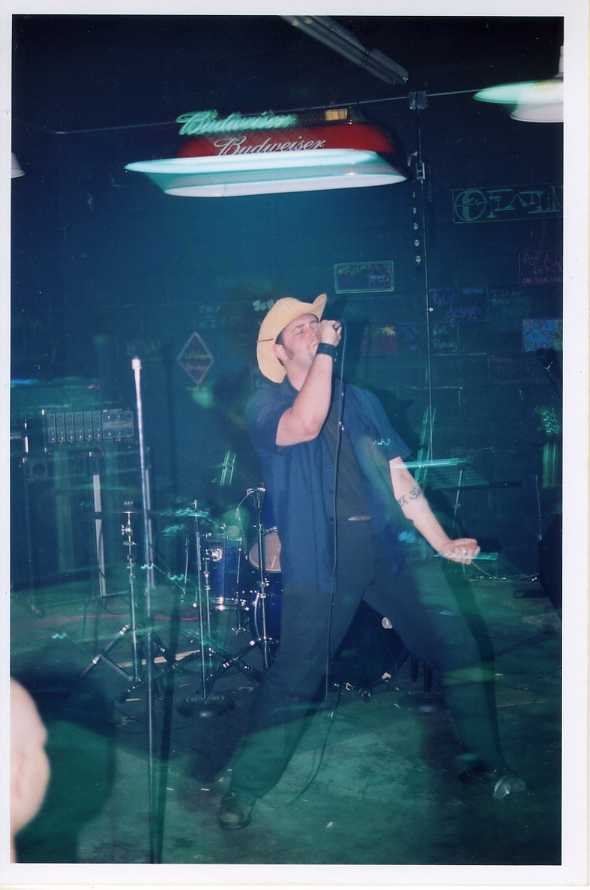
It’s Not Mud

One of my tourmates at the Texas Blues Bar

One of my tourmates at the Texas Blues Bar, summer of 2002

You walk into the Texas Blues Bar and wonder if you’re gonna have to fight your way out. It’s that kind of joint. Two pool tables to your left, and in front of you is a long bar with twenty or so Texans sitting on barstools. All of them looking at you. It’s a row of mesh-back hats and blue work shirts, but these guys aren’t hipsters wearing thrift store clothes ironically. The work shirts have the right names sewn on the patch. The guys wearing them are wearing them because they stopped at the bar on the way home from work. You can just tell. And even the women around here look tough—not necessarily like they could kick your ass, but not necessarily like they couldn’t, either. But what can you do? Just keep walking like you know what you’re doing.

One of the pool tables is open. A guy is sitting on the stool next to the table. He’s got a pool cue in his hand. He’s looking for a game. It’s a good way to acclimate yourself to the crowd, so you head over there. Put two quarters on the edge of the table. Say to the guy on the stool, “Is this your table?”

He nods.

You say, “Wanna play a game?”

He nods again and stands up. He’s every inch a Texan: cowboy boots, tight blue jeans, camouflage T-shirt, and a fluorescent orange, deer-hunting baseball hat. He’s also about four feet tall. You’re not sure why that matters, but it seems to matter right now. Playing pool with a little guy just seems to make the evening perfect.

You drop the quarters into the slot, release the balls, and start to rack them. The little guy chalks up his pool cue. You say to him, “What are you up to tonight? Just having a beer on the way home from work?”

“Nah, man,” he says in a thick, Texan drawl. “I’m here for some readings. There’s some literature and shit going on here tonight.”

Any apprehension you may have been feeling wanes as soon as he says this. You are, after all, one of the guys reading. Bringing literature and shit. You smile and pull the triangle off the pool balls. “Should be cool,” you say. “Break ‘em.”

The pool game gets underway. The little guy isn’t very good, but can you blame him? He’s four foot tall and the table is three foot tall. Do the math: you’d have to find a pool table four and half feet tall to try to see things from his perspective. He doesn’t seem to care that he’s losing, though. He just wants to talk about punk rock and the bands he’s seen. He doesn’t tell any stories about the bands. He just says the name of the band and asks if you’ve heard of them. Like this:

“I saw NOFX,” he says.

When he doesn’t go on, you say, “Oh yeah?”

“Yeah,” he says. “You heard of them?”

“Yeah.”

Silence.

He does this several times. Sick of It All. You’ve heard of them. Strung Out. You’ve heard of them. Swingin’ Utters. You’ve heard of them. Lagwagon. You’ve heard of them. No Use for a Name. You’ve heard of them. Big Boys. You’ve heard of them. You stop him here. “Really?” you say. Impressed, because he doesn’t seem old enough to have seen the Big Boys. “You’ve seen them?”

“Nah,” he says. “I was just seeing if you’d heard of them.”

And so two pool games pass, just like that. The little guy has seen just about every band on the Fat Wreck Chords roster. That’s about all you learn about him. Well, that and that he’s damn proud of this accomplishment. And that he’s not very good at pool, but you learned that almost right away.

So you quit playing pool and wander around the Texas Blues Bar. You walk along that long bar. Your two tourmates are drinking at the far end of the bar. Before you make it that far, someone calls out your name. You turn and look. It’s the bartender/booker/manager, Roy. Roy is also your friend. He’s the reason why you’re in Longview, Texas. His shift must’ve just started, because he wasn’t behind the bar the last time you got a drink. You’ve been waiting for him, though, so you could figure out if there’s a drink special for the entertainers: i.e., you. Before you can ask, Roy hands you a Lone Star. You reach for your wallet. He shakes his head. So that’s the drink special: drink; you’re special.

Two guys who are obviously auto mechanics are sitting at the bar between you and Roy. They’ve got dirt and axle grease deep in the wrinkles of their fingers. They smell like hand cleaner. Roy points at you and says to them, “This here’s the guy who does Razorcake.”

“No shit?” says one of the mechanics. He’s wearing an American flag bandanna.

“Well, I’m one of the guys,” you say. “I mean, I don’t put it out by myself.”

“I love that fucking rag,” the bandanna guy says.

“Thanks,” you say.

“Listen, there’s something I want to ask you,” he says. He looks very serious. “Is Ian MacKaye gay?”

You almost say, “I don’t know. I never tried to fuck him.” But you stop yourself. No need to be a smart ass. The only problem is, if you don’t give a smart ass answer, you don’t have an answer at all. It’s never occurred to you to wonder whether or not Ian MacKaye might be gay. So you stick with, “I don’t know. Why?”

“Just wondering,” the guy says.

Roy tells you that the reading will start at around nine o’clock. It’s seven now. Roy assures you that everyone in the bar is there to see you guys read. There are also a couple of bands playing. The order is: reader, band, reader, band, reader. You’ve done enough shows to know that this is a recipe for disaster. But you don’t say anything, because you trust Roy and also because you seem to be in a place where the rules of the rest of the world don’t apply. So you just go with it.

sean_col_28

My tourmates dancing at the Blues Bar.


Nine o’clock rolls around. The Texas Blues Bar is packed and everyone’s drunk. There’s a room to the right of the bar that you didn’t see when you first walked in. It looks exactly like a two-car garage—big and open, concrete floors, no windows. The only thing missing is the garage door. This is where you’ll perform.

The poet you’re on tour with starts things off. It’s tough. There’s no stage. The first band’s equipment is set up behind him. And, even though the bar’s packed, only about a dozen people walk over to see the poet. He starts his act. You’ve seen him go through this ten times on the previous ten nights. You started the tour in Boston and have made it all the way down and around to here. You know word for word what he’s gonna say, how he’s gonna say it, when the crowd will laugh, when the poet will have the crowd hooked. Only, tonight, again, rules are off. He’s not getting the easy laughs. No one’s walking over from the bar to check him out. In fact, the crowd in this room is starting to thin. The poet cuts his set short.

This doesn’t bode well for you. You don’t read poetry. You have that going for you. But you do read short stories. Or, at least, you tell them. And the shortest of the short stories takes ten minutes to tell. If things go badly, you’re still stuck up there for ten minutes. And ten minutes can be forever when you’re bombing. You try to tell yourself that a lot of people here know Razorcake, so it may be better for you. But you know where Razorcake sells, and how many copies. The numbers just don’t add up. Still, you remember that you’re in a strange place. Rules don’t apply. Just ride it.

The band gets started. The lead singer is wearing a coveralls and a cowboy hat. He’s that weird kind of hybrid that you’ve been seeing all night: too punk to be a shitkicker, too shitkicker to be a punk. And that’s exactly what the music sounds like. And that’s exactly how the crowd looks. It’s a perfect fit. So perfect you get swept up in it. You get out onto that concrete floor and dance. Why not? Burn off some nervous energy. Get a good sweat going. Bounce into some Texans. Have fun.

Before you know it, the band’s done and you’re up.

Here you go. Bringing the literature and shit. Forty or fifty shitkicking punks are looking at you. You look back at them. It’s too late to wonder how it’s all gonna go now because it’s all going. You introduce yourself and tell a lame joke and someone to your left laughs like hell. You look at who’s laughing. It’s the little guy you played pool with. Game on.

You start to tell a story about working construction when you were a kid. It’s a more-or-less true story. You changed things to make it better, but you’ve told it so many times that you can’t remember what you changed and what’s real. The story is blue collar and it’s funny and sad. And so is the crowd. They seem to be digging it. They stay to listen, tipping Lone Stars, smiling, laughing sometimes when you don’t even expect it. The little guy is to your right with a big ol’ grin on his face. And you get to one part of the story. This is the hook. This is what you’re hoping will connect with the people around you. It’s the part where the narrator is hitting on a girl. He’s spent the day busting open a septic tank. He rubs the back of his head and finds a chunk of mud. You tell them that. The room goes silent. “Then,” you say into a sea of big eyes staring at you, “very slowly, I realized…”

And the first shout goes out. It’s the geeky chick who’s been hitting on every dude in the bar that night. She yells out, “No you didn’t!”

“Oh I did,” you tell her. “I realized…”

“Oh shit,” the little guy starts yelling. “Oh shit, oh shit, oh shit!”

“Tell it,” someone else screams. And suddenly you feel like you have a tent revival on your hands. They’re waiting for the punch line—hollering out encouragement, seeing what’s coming, even—and you can’t deliver it. Not yet. It’s all too right. The energy is too good. You have to feel it for a few seconds, at least.

But the seconds pass and you tell them, “I realized: that’s not mud.” The room goes nuts. This part of the story isn’t even that funny. At one reading on this tour, a girl even said, “Awww,” when you said this line. Like she felt sorry for you. Not these Texans, though. They hoot and holler. The little guy even slaps his fluorescent orange hat against his knee. Goddamn.

You keep going. You finish your story and someone even gives you an “Amen.” Amen.


Forty-five minutes later, after the second band has played and your second tourmate is halfway through his set, half of the room suddenly clears out. You have no idea why. Your tourmate is giving a hell of a reading. You’re enjoying it, and you’ve heard this stuff for ten days straight. Later, you’ll find out there was a fight in the parking lot. You’ll learn that one of the fighters broke the other fighter’s leg. You’ll spend a few hours wondering how someone breaks someone else’s leg in a fight. Spinning toe hold? Before all that, though, you’ll just kick back at your merch table and watch the room clear and be happy to watch your tourmate bring his literature and shit. You don’t need to see the latest spectacle. You’ve already gotten what you came for.


Author’s note: This is the seventh chapter to a collection of Razorcake columns I wrote.  It originally ran in Razorcake #28.  For more information about the collection, read this post.

Team Donofthedead

Illustration from Razorcake #50 by Brad Beshaw

Illustration from Razorcake #50 by Brad Beshaw

The Dogtown documentary doomed us.

Don scored us a couple of tickets for an advanced screening. There was a beautiful sense of excitement before the film, hanging out in the morning fog of downtown LA, standing in the very spot where Jon Fante starved and typed and wrote about starving and typing in Ask the Dust. And the documentary was good. A lot of cool, old skating footage, anyway.

That’s what Don and I talked about afterwards: the skating footage. We didn’t talk about the part in the movie when the filmmakers chose to show a map of Los Angeles and put a star on Paul Revere High School, thereby alerting filmgoers everywhere to the exact location of one of LA’s best kept secrets. The fuckers who showed the map were the same fuckers who talked about beating up anyone who gave away their secret skate spots. So be warned, Stacy Peralta: if I ever see you in person, I’m going to punch you in the head. Because, sure enough, the week after Dogtown and the Z Boys was released nationally, an eight-foot high fence was constructed around the Paul Revere parking lot, a twenty-four hour security guard was hired, and signs promising to arrest skateboarders were hung intermittently.

I wasn’t much of a skateboarder prior to moving to LA. I did have a skateboard. It was about forty-five inches long. When I lived in Cocoa Beach, I used it to ride down to the beach and check the waves. Sometimes, I’d ride it to a downtown bar or to the library.

The move to LA changed things considerably. For one thing, I was painfully poor that first year. Todd Taylor and I were trying to get Razorcake off the ground. Nearly every cent we had, we poured into the magazine. Nearly every cent we earned, we turned back into the magazine. One of the strange side effects of this poverty was that I started getting fat. The Mexican joint around the corner sold huge burritos for three dollars. And, when you’re surviving on about thirty bucks a week, six-for-a-dollar packs of Top Ramen seem like a good idea. So, yeah, you gain weight. Skateboarding seemed like a good way to counteract a cheese- and corn tortilla-heavy diet. The problem was, I was too poor to buy skating gear.

Don took care of this.

You may know Don as Donofthedead, a legend of the Razorcake record review section. But Don is more than a guy with fifteen thousand records in a back room in his house. He’s also the unacknowledged skating guru of Razorcake’s early days.

Don solved the problem of my longboard skate. He passed on to me a deck that allowed me to maneuver the high banks of Paul Revere without breaking my neck. I put my big, soft longboard wheels on that deck, and Don again took pity, scoring for me a set of harder, faster wheels. When he saw me fall one too many times, he passed on a set of camouflage knee pads, a little cracked on the left knee but nothing shoe goo couldn’t fix. When he ordered a pair of Vans that were too big for him, he passed them on to me instead returning them. Thus, I was inducted into Team Donofthedead.

In that first year of Razorcake, we skated Paul Revere nearly every weekend. Todd and I did. Don came along most weekends. Various other Razorcakers joined us occasionally. The first time I skated there with Don, he still had a cast on his wrist from a spill he’d taken several weeks earlier. At least I think he did. (If Don’s wife is reading this, then I stand corrected. Don never skated with a cast on his wrist.) Shortly after he got that cast off, he took another spill and broke the other wrist. He wouldn’t admit that it was broken. We had lunch at a noodle shop after the session. Don worked his chopsticks with fingers that were turning blue, just past a wrist that was swelling to three times its normal size.

Paul Revere was a great place to get back into skating. It was basically a parking lot cut into a hill. On three sides of the parking lot, the hill was paved going up about twenty feet. There was also a road coming in from a higher parking lot, so you could roll down the road and gather enough moment to ride up and down the hill as if it were a ten-foot wave. After about twenty yards of this, you ran into another paved, ten-foot high hill that you could roll up, kick turn, roll down, and ride the wave back to the road. It’s hard not to love a place like that. We showed it love in a way antithetical to the image of punk rock skateboarders. We brought push brooms and swept away the stones before skating. We picked up any trash that might be in our way. We left the place a little nicer than we found it. Then, that bastard Stacy Peralta made his self-aggrandizing documentary and Paul Revere was a bust.

Next, we started skating at an abandoned pool out in La Habra called the Jungle Bowl. It was a frequently graffitied spot. Whenever the skateboard wheels hit fresh graffiti, the surface would get slick and you’d slide. Sometimes this was fun. Sometimes, it was painful. We told Razorcake photographer Dan Monick about the spot—an abandoned pool cut into the high-priced hills of the LA suburbs, weeds and new growth taking over when a house had once stood and burned down, everything east to Riverside visible on clear days. Dan wanted to come with us and take photos. The spot was as picturesque as Dan pictured it, and he started snapping right away. Unfortunately for him, he expected Todd and me to be like those X Games skaters. The only time we caught any air, it was accidental and ended with a splat. Not great for photographs. Lucky for Dan, two other skaters showed up midway through the session. One of them was pretty amazing. He performed feats worthy of Dan’s camera.

We skated Jungle Bowl for a few months. I tried and tried without success to get enough momentum to carve above the pool light. I found a line that would get me just below it. Before I could find that new, perfect line, local high school kids started partying out at Jungle Bowl on weekends. Cops started noticing. The property owners repaired the break in the fence. They posted no trespassing signs. The cops added the spot to their regular patrols. Rumors circulated about skaters getting arrested. Jungle Bowl was a bust. We started heading to city skate parks.

Don taught me how to drop in at the San Dimas skate park. He taught me to power slide at the skate park in Whittier.

By this time, Razorcake was up and running a little more regularly. Money wasn’t quite as tight. We had a little leeway with regards to ad space in Razorcake, so we started making trades with Mike at Beer City Skateboards. I got a Duane Peters deck, wide trucks, new wheels, the works. I passed the deck that Don had given me on to Razorcake illustrator Art Fuentes. In that way, he joined Team Donofthedead.

For a while there, it seemed like I was spending a fair amount of time with Team Donofthedead. We hit a number of parks from Pico Rivera to Montalvo. The city of Duarte put in a new park right alongside the 210, and we explored a little less and skated there a little more. We spent a lot of time at the Whittier park, too, because Art lived around the corner from there.

Don was a little less stoked about the parks. He liked the hidden skate spots. One weekend, he and some friends hit an abandoned pool somewhere on the west side. He took a nasty spill and landed on his back. The next weekend, Don and I skated the park in Brea. Don took one spin around the bowl and decided to sit out the rest of the session. I took my turns, but mostly hung out and chatted with Don. He kept talking about the spill he’d taken. His back was still hurting from it. A week later, he had to have back surgery. His skating days were over.

Todd, Art, and I talked about this a few weekends later at Whittier: Todd with Don’s old trucks and wheels under his deck; Art with Don’s old deck and wheels; me with Don’s old knee pads and shoes. It was a sad moment. It was the real beginning of the end.

 *

The skate park in Upland is gnarly. It has a huge half-pipe going into a full pipe and ending in a bowl. You can drop in from the top or roll in from a four-foot-high ledge. I’d been having a good day rolling in from the ledge and riding the half pipe into the full into the bowl and back. Then, this old guy came along and started tearing shit up. He made dropping in from the top look so easy. I couldn’t resist.

Just before dropping in, I said to Art, “I don’t know why I’m trying this. It doesn’t matter if I can do it. It does matter if I break my arm.”

Art smiled.

I dropped in. It worked. I carved up and down the half pipe and thought, damn, this is fucking awesome. I made it into the full pipe with way too much speed. My trucks started wobbling. I tried an ill-advised power slide while about twelve feet up a wall, ended up taking the short cut to the ground and snapping a wrist bone in half.

Before my cast was off, Art blew out his knee at Whittier. Before Art could walk again, Todd broke his leg in two or three places at the park in Glendale. Team Donofthedead was done for.

Now, when I think about the early days of Razorcake, I think a lot about Team Donofthedead. I think about it mostly when I ride home from work and pass the new onramp, where a retention ditch has a road that runs alongside a bank paved into a hill. It looks like another Paul Revere carved alongside the freeway. I sometimes spend the last five miles of my commute imagining Team Donofthedead climbing the fence and riding that ditch in a world where cops won’t kick us out and our bones and tendons are young enough to take the impact.

These days, I mostly go surfing alone. Maybe it’s not quite as fun, but wipeouts are way more forgiving.

Author’s note: This is the sixth chapter to a collection of Razorcake columns I wrote.  It originally ran in Razorcake #50.  For more information about the collection, read this post.

Poisoning Schoolchildren and Other Patriotic Activities

sean_col_10_by_dan_monick

Photograph from Razorcake #10 by Dan Monick

With five minutes left to go in class, the principal came on the loudspeaker to tell everyone that a rocket had exploded, releasing a poisonous gas cloud. No one was allowed to leave their classroom until the poisonous cloud passed. So there I was – perhaps the world’s most reluctant junior high school teacher – stuck with thirty-five twelve-year-olds, waiting for a poisonous gas cloud to pass. Since there were only five minutes left in class, all of our classwork for the day was done. Since I was a first-year teacher in a horribly under-funded school, I didn’t have my own classroom. I roamed from one classroom to another during the day, bringing whatever books and supplies I could carry. This meant that, in case of emergency, I had no back-up materials: no games for the kids to play, no books with stories that I could read to the kids, no movies to show. Just to aggravate matters even more, when the poisonous gas cloud showed up, I was teaching in a football coach’s classroom. He had no back-up plan either. He once told me, “When kids get bored and act up in class, just make them do jumping jacks. It tires the little bastards out.”

The only thing I had going for me when the gas cloud floated overhead (and on any other day that I taught junior high, for that matter) was that I was big and mean-looking. I kept my head shaved pretty close to the scalp and I wore Doc Martens to school every day and a few of my students had seen me at an all-ages US Bombs show earlier in the semester, going nuts in the pit and doing shots with Duane Peters, and those students told everyone in the school about it. So I wouldn’t say that the students feared or respected me, but I could occasionally intimidate them.

The principal had said that the gas cloud would pass in forty minutes or so, so I figured I’d just move on to the next day’s assignment. I stood up and told the students to quiet down and open their books. I opened my planning book and glanced down at my lesson plans for the next day. Prepositions. Jesus, I thought, as boring as grammar normally is, this may be the most boring part of it. I launched into the assignment anyway, talking about how a preposition is anything you can do _____ a cloud. You know: in a cloud, underneath a cloud, surrounded by a cloud, etc. – which probably wasn’t the best way to explain it, what with the poisonous gas cloud above us. I talked for a couple of minutes, then asked one student to give me an example of a preposition. He said, “Who cares?”

“No, ‘who cares?’ is an interrogative statement,” I said. “Who can give me an example of a preposition?”

Stacy, a pretty intelligent smartass, raised her hand. I gambled that she might actually be taking a shot at the question and said, “Yes, Stacy?”

“Are we going to die?” Stacy asked.

“You’re getting closer,” I said, undaunted and acting naïve. “‘To’ is a preposition, but not in that sentence. When you say, ‘Are we going to die?’, the ‘to’ in that sentence is half of the verb form, ‘to die’, which is actually an infinitive. Who can use ‘to’ as a preposition?”

Stacy’s friend Kia raised her hand, and though I felt like it was futile, I called on her anyway.

“Are we gonna die, Mr. Carswell?” Kia asked. And when Kia asked the question, it changed everything. Because I knew Stacy was just trying to stir up some shit, but Kia was genuinely scared. And Kia had every right to be scared. There was a poisonous gas cloud floating by outside, and the only thing that separated inside from outside was the quarter-inch-thick glass windows. The windows were shut. They were sort of weather proof. Not a whole lot of poisonous gas could creep in, but still. Some poisons are pretty strong. It doesn’t take a whole lot to fuck you up.

As I thought these thoughts and weighed the options of what type of gas this might have been and how far away the rocket had been when it exploded and how real this danger really was, the absurdity of my whole situation struck me. All of these kids were freaked out by the cloud, and I was trying to teach them about prepositions. I closed my book. “I’ll tell you what,” I said to the class. “Take out a sheet of paper and write about this cloud that’s passing over us. Write about what you think it is, and why you think it’s up there, and what you think of Kennedy Space Center taking chances with your life by sending a rocket full of poisonous gas up into the air above us.”

Most of the kids took out a sheet of paper and started writing. I sat back down at my desk, keeping an eye on the kids and thinking about rockets. At the time, I was living in Cocoa Beach, Florida, which is the town I where I was born. One town over from Cocoa Beach is Merritt Island. That’s where I grew up. And on the north side of Merritt Island is Kennedy Space Center, which is where, among other things, scientists designed the rockets that went to the moon. So I grew up with rockets. They were nothing new to me. When I was a baby, my mom would carry me out to the front yard so we could watch the Apollo rockets head to the moon. As soon as I could walk, I’d go out to the front yard on my own to watch the rockets. After I learned to read, I started reading the newspapers on the day of a launch. I’d memorize the crews’ names and their missions and which rocket it was: Apollo or Skylab or the Columbia Space Shuttle. I’d even read up on the test launches and satellites. I tried to learn about everything that the Space Center fired up in the air. Of course, by the time I was twelve or so and my hormones kicked in, I’d completely lost interest in rockets. And, yeah, I’ve heard all the arguments about rockets just being an extension of men’s penises, or a metaphor for man’s desire to stick his dick into everything, even outer space, but by the time I was in junior high, the only penis I cared about was my own. So I stopped thinking about rockets and stopped going outside to watch them shoot up into the air and started focusing more attention on girls.

I looked across the classroom at my students. About half of them were busy writing on their papers. The other half had given up on the assignment, but they weren’t misbehaving yet. I watched Kia, who was kind of a punker in the sense that she wore black t-shirts a lot and dyed her hair crazy colors and was a free-thinker (well, for a twelve-year-old), but was mostly not a punker in the sense that her favorite band was No Doubt. The combination of her blue hair and the rocket that had just blown up reminded me of Angie Huber, a punker girl who I’d dated for about a week in junior high. Angie’s stepfather, a guy named Fred Haise, had been an astronaut. I only knew this because Angie’s mom always made a big deal about it. She’d always say his first and last name together, even though he was her husband, like everyone should know who Fred Haise was. According to Angie, though, he was just an asshole. The one time I met him, I could see her point. Not that he really did anything all that bad. He just criticized Angie a lot and looked mean when he did it. But Fred Haise had been on the Apollo 13 mission. He was one of the guys who had been in the rocket when they supposedly reported back to Mission Control, “Houston, we have a problem.” Then, of course, they made a Tom Hanks movie about the Apollo 13 mission, but I didn’t see the movie, and I never really did give much of a shit about Fred Haise. I did give a shit about Angie, though. I gave a shit about any girl who was goodly enough to make out with me behind some school busses when we were thirteen. I sat at the front of that classroom and thought about Angie and wondered what ever happened to her and if she still hated her stepdad and what she thought of that Tom Hanks movie.

I couldn’t do this for long, though, because the poisonous gas cloud was still floating over us, and most of my students had given up on their writing assignment. They were gradually working themselves up. It started with a few students talking quietly at their desk. I never did much to stop this, and I was too busy thinking about Angie, anyway, to stop anything. The talking got louder as they tried to hear themselves over the other voices talking. I made idle threats about sending them outside into the poisonous gas cloud if they didn’t shut up. My heart wasn’t into my threat, though, and the kids sensed it. They kept talking, and when it got too loud for them to hear the person who was three seats away and talking to them, they started to leave their seats and walk around. This was the point where, as a teacher, I was supposed to stand up and do something. Shut the kids up and stick them back in their seats. But I didn’t do anything. I’d always stopped them before they got to this point, and I was curious to see how far they would go. Pretty soon, more than half of my students were out of their seats and walking around, chatting with each other. Their voices echoed off the concrete walls of the classroom, and it almost seemed like a party. A few students even walked up to my desk to chat with me. I asked them if they’d seen Apollo 13. They said that they had, so I told them about Angie Huber.

“Which one was Fred Haise?” Laura – one of my pets – asked me. “Was he Tom Hanks or Kevin Bacon?”

“I don’t know,” I said. “I didn’t see the movie.”

“I think he was the other guy,” said Travis, another of my students. “I think Fred Haise was the funny looking one.”

“The one with the wife and the little baby?” Laura asked.

“I think so. Maybe not,” Travis said, and he was about to explain why Fred Haise might not have been the funny looking one when two kids started fighting in the back of the classroom.

I watched the two kids go at it, but didn’t do anything. Laura pointed out the obvious by saying, “Mr. Carswell, Billy and Glenton are fighting.”

“Yes, they are,” I said. I thought about getting out of my seat, walking across the room, and breaking up the fight, but decided instead to let it go. Billy had been asking to get his ass kicked for the past couple of weeks, and Glenton’s mom was a hooker. I figured it would do Billy some good to be humbled and it would do Glenton some good to let out some of his rage. Besides that, there was a fucking poisonous gas cloud outside. Deep down inside, I felt like all bets were off. I felt like, if society’s gotten to the point where Kennedy Space Center is sending poisonous gas into outer space in one of those great, big, explosive hunks of metal that they call a rocket, and if that explodes and that gas floats over me and the junior high school where I teach, and if the best thing they can do after sending that gas cloud over my hometown is to say, “Uh, you guys need to stay inside for a half hour until it passes,” then, obviously, this society has no rules. So fuck it all. Let ‘em fight.

The kids gathered around the fight, but no one stepped in to break it up. Glenton wrestled Billy to the ground and his fists rained down on Billy’s face. Billy managed to cover his face with his forearms. Glenton whaled on Billy’s forearms and ears and the side of Billy’s head. A few girls told me that I had to stop the fight. One girl started crying. Some of the boys cheered for Glenton or encouraged Billy. Most of the boys just watched. They seemed hesitant, as if they didn’t know whether or not they should stop the fight. Still, I did nothing. I let them fight. Part of me thought that surely another teacher would hear the commotion, rush into my classroom, and break up the fight. But, of course, that couldn’t happen because no teachers could leave their rooms and come into mine because there was a poisonous gas cloud floating through the halls.

Then, something strange happened. It was almost like a realization spread across the room. I think it started with Glenton. I think Glenton was on top of Billy, pounding his fists into Billy’s head and getting really tired when Glenton realized that I wasn’t going to stop the fight. And if I wasn’t going to stop it, no one was. And if no one was going to stop the fight, what was gonna happen now that he was too tired to punch Billy anymore? What was Billy gonna do? And if no one breaks up a fight, how does the fight end? I think Glenton realized this because he stopped punching Billy, got up, walked to his desk, and sat down. Billy stood up, too. His face was bright red and his hair and back were covered with dirt and debris. A paper clip clung to his cheek. He didn’t go anywhere for a few seconds. He just stood there, taking deep breaths. Then he, too, went back to his seat and sat down. The rest of the kids just stood around, not talking, not doing anything. Just standing there. Gradually, they all sat down, too. I can’t really explain it. Maybe they reached the end of their rebellion, and they had nowhere to go but back to the beginning. Or maybe I scared them by not breaking up the fight. Maybe they realized that, with the freedom to do whatever you want comes the responsibility to respect others, or else those others might kick your ass. Or maybe the fight just wore them all out like so many jumping jacks.

When they were all in their seats, Kia raised her hand again and finally asked the question they all should’ve asked right from the beginning. She said, “Mr. Carswell, if it’s so dangerous to everyone, why do they put poisonous gas in rockets?”

“Because the people at the Space Center – and the US government, too – take a lot of chances with our lives,” I said.

Kia nodded. She seemed to want to ask me more, but she didn’t. Justin picked up where she left off and said, “What do you mean?”

“Kennedy Space Center does all kinds of crazy stuff,” I said. “Have you guys ever heard of the Cassini Space Probes?” A few students shook their heads, so I explained that it was a rocket with plutonium in it. The class didn’t know what plutonium was, so I told them that it’s a radioactive substance. I also explained how dangerous it was for KSC to put a radioactive substance in a metal container on top of tons of very explosive fuel, then to set that fuel on fire. I explained how it was very different from, say, launching a nuclear missile, but the mechanics of the Cassini Space Probe and the mechanics of a nuclear bomb weren’t all that different.

Another student raised her hand. “I don’t understand,” she said. “I thought the Space Center just made the shuttle and stuff?”

“Oh no,” I told her. “Mostly what the Space Center makes is bombs.” This seemed to interest the kids even more than Glenton and Billy’s fight did, so I decided to go on that tangent. I told them that rockets were first made by the Nazis in World War Two so that they could kill a lot of people from a long way away. And that the top two Nazi scientists who developed the rocket bombs, Werner Von Braun and Dieter Huzel, came to America after World War Two and headed up the space program. I told them about all the different weapons they developed out at the Space Center, like various Inter-Continental Ballistic Missiles, nuclear submarines, and the SCUD missiles that the US Army used to kill a bunch of non-violent Iraqi civilians. And I just kept going. I was all worked up, partly because of that damn poisonous gas cloud, and partly because I hated the whole idea of the Space Center. It killed me that I had only two real employment opportunities in my hometown. I could either take a shitty job in an under-funded school, making lousy money and struggling to teach thirty-five twelve-year-olds about prepositions; or I could go out to the Space Center, where I would get paid twice as much to develop more efficient ways to kill as many people as possible from as far away as possible.

I knew that most of my students’ parents worked for the Space Center, and that I’d probably get into a lot of trouble when these kids went home and told their parents what I’d said in class. But I didn’t care. I figured that people who dump a poisonous gas cloud on their kids’ heads don’t have a lot of room to complain. So I went on and on about the problems with bombs and rockets and missile defense programs, and, for once, my students really listened to me. Not one single student talked while I talked. No one passed notes or kicked the kid in front of him or put trash from a spiral notebook into a young girl’s hair. They just sat there and listened and actually learned something useful.

Finally, the principal came back on the loudspeaker and told us that the poisonous gas cloud had passed. We were all allowed to leave our classrooms and go outside. I stopped talking and a few of my students actually groaned because they wanted to hear me slander the Space Center even more. I packed up my stuff, too, and got ready to head off to my next classroom and to teach my next group of kids. As I did this, I watched my students file out. And I thought, damn, these kids would be good students if the Space Center threatened to kill them every day of their lives.

Author’s note: This is the fifth chapter to a collection of Razorcake columns I wrote.  It originally ran in Razorcake #10.  For more information about the collection, read this post.